* NOTICE: Mr. Center's Wall is on indefinite hiatus. Got something to say about it? Click HERE and type.
Showing posts with label bible. Show all posts

Saturday, December 17, 2011

See, here's the thing about symbols:

Christopher Hitchens is dead.  Facebook was alive with the news for, uhm, about a day: "The world is a lesser place without him," some said (though apparently not so lessened that the effects of his demise reverberate beyond several hours).  I'm not too chuffed, but mostly just because I know so little about him, not because I have any particular ax to grind.  However, his death, together with the typical convergence of events or things read that generally lead me to a post like this, have made me think about a few things.

Hitchens wrote a book:  God Is Not Great, in which he asserts his atheism and appears to attempt an undermining of religion.  Apart from the utter futility of such an endeavor (I'm not sure that even God could dissuade just the moderate zealotry (you know, without pressing his "Smite" button, and all); and besides, I mean, c'mon! -- did such an intelligent person as Hitchens really think he could successfully attack and undermine something so essentially illogical with carefully meted and tempered argument, or was he, so much more likely, just trying to sell copy?), he makes some interesting arguments, the vast majority of which I'm not interested in here.  One of his weaker assertions, however, is an attack on the anachronisms--the "ill-carpentered fictions"--of the Bible, which affords a starting point for my discussion.

Let me be the first to say, and despite my love for the Bible, that the tome is chock full of some of the strangest tails and details I've ever come across.  Hitchens thinks so, too (one of the very few upon which we agree).  The Pentateuch, for instance, holds Moses doing and saying some weird stuff--freaky weird, even.  What Hitchens doesn't seem to acknowledge (or, well, he does, but sites it as a further weakness (and I'm not fighting that claim right now)) is the effects of the passage time, one linguistic/cultural and the other human error/interference.  Anyone who studies the Bible will cheerfully acknowledge the dire effect of imperfect people working on or on behalf of the scriptures--the otherwise perfect Word (of course, for most of us, one of the great benefits of the Bible comes directly from the very effort involved in parsing Truth from among all the problems) --not all of whom had good intentions.  But even under the best circumstances, people, despite God's perfection, make mistakes (and those who believe and really think about it will allow that God even permits these mistakes), so many of whom appear in their efforts to forward God's word.  Bigger still, however, than the weakness of even the best-intentioned of men (and there were plenty of malingerers), is the effect of cultural development.  Anachronisms aside, to us today, there's an awful lot, especially from the earliest books of the great Library, that doesn't make much sense and/or contradicts itself.  This brings me to the next of the convergences and closer to my ultimate point.

Languages and cultures shift and change.  Don't believe me (and, crap if you don't, you're freaking obtuse!)?  Just read a week's worth of posts from The Language Log.  Without putting too fine a point on it (and we've talked about it before vis a vis translation) it is essentially impossible--or, at best, impractical--to manage perfect cross-cultural  or cross-language shifts: a translation.  The best we can manage, and we can manage pretty well, is interpretation (hence the art and skill of interpreters against the woeful ineptitude of things like Google Translate and Word's grammar check) --interpretation which requires a ladder into the ether of metalanguage, which we are definitely not going to broach today.  The point is we cannot--EVER--perfectly understand a person of a different language and culture.  Period.  Move this to an extremity of language and culture like that of freaking Moses, and ... well ....  Get the point?

As it's Christmastime, cards and letters are starting to come in from family and friends.  In our house, we post these decoratively upon the cupboards of our kitchen.  Generally, the missives convey family news -- count on my dad to take a different tack (and I don't remember him ever being the one to scribe the annual letter for my folks; how things change!).  He talked about a conversation he and my mom had had regarding the interpretation of a word at the end of "Away in a Manger": "and fit us for heaven," the word fit, particularly, as it ... er ... fits in the line and within the song.  Unfortunately (for the issue at hand here, not the elegant point made by my father in his letter), fit is a pretty boring word, meaning essentially the same thing now as when the song was first published and even three hundred years before that.  The only difference in our uses of fit now as from before is a drop, inasmuch as Lewis Carroll did not mean, or at least did not only mean (most likely he meant both together) fit as a strong, sudden, uncontrollable physical reaction, but a canto: "The Hunting of the Snark, an Agony in Eight Fits."  This difference or change or shift or lack, or whatever you want to call it, in fit's etymology can still be sort of retrofit into the interpretation of the song, at least as a symbol.  And this is the point.

Symbols change just like words and language and culture.  (And I could write a book about this, but we're gonna keep it limited -- hopefully.  Besides, there are others far better qualified than me.)

There are all kinds of symbols, and you should get what I'm talking about by my saying that there are both universal symbols and one-use-only symbols.  The best source I can think of for any symbol--a specific symbol or type of symbol--is literature (go figure).  Authors and poets certainly use both, but the difference should be clear in, say, Catcher in the Rye, where Salinger applies a potentially universal symbol of a cliff and a very specific, one-use-only, symbol of a song lyric.  

(Want more symbols?  Dig out your freshman lit book from high school or even college.  I'd examine my own, but it's buried in the garage.  One in particular that I re-encountered recently is that of bells.  Consider their effect on faeries (or pixies -- you pick), but also in Longfellow's "I Heard the Bells on Christmas Day," Poe's "The Bells," and Tennyson's "Ring Out Wild Bells.")

Symbols like these, universal or not (another universal symbol, perhaps easier to see, is the black bird, used in both Through the Looking Glass and Tortilla Flat, among so many others), remain fixed, at least inasmuch as their value is fully encapsulated by the text of the book.  Regardless of cultural elements connected to the symbols or their cultural sources, the application of the symbols are self-contained.  Well, often.  Not always.  Consider Jane Eyre.  Early in the book, in the red room, there's the nastiness about the chimney.  With the exception of Santa Claus, we've largely lost our superstitions, and therefore associated symbolisms, of chimneys.

This brings me to my gripe.

It really bugs me when hyper-Christians get all bent out of shape about the "real meaning" of Christmas symbols (as distinguished from "the real meaning of Christmas," which is certainly not in dispute here; and the same goes for Easter): the Christmas tree, the yule log, Santa coming down the chimney, wreaths, poinsettias, and so on.  Easter eggs.  Generally, the hyper-Christians' gripes boil down to pagan rituals and druids and fertility rites and, somehow, the consumerism of the Holidays.  (If you're really ambitious, check out the symmetry between the development of our cultural symbols against the history of our English language.  Cool.)

(Are you offended by my coinage of "hyper-Christians"?  I apologize.  Anyway:)

Here's the thing: Sure, go through the histories--which interest me just as much as the next nerd--and, yeah, that's where a lot of this stuff got started.  But that's not what they mean anymore!  Things change!

Are you still scared of witches coming down your chimney?  I've never roasted a chestnut, but chestnuts are much closer to my cultural nostalgia associated with chimneys than hobgoblins.  (Actually, the majority of my  personal associations with chimneys involve me as a kid getting into a heckuva lot of trouble.)

Just because the symbol itself--the physical thing--persists, and entirely by tradition only (a thing much more rigid than whatever that tradition might have stemmed from (consider how many people go to church on Christmas and Easter not because they believe anything in particular--or particularly strongly--but just because that's what you do on Christmas and Easter)) doesn't mean that it's wrong to hold onto that thing!  It doesn't always matter what something means, but that it means something at all.  Think about it: what do the Christmas tree and the presents and the cookies and the fireplace and the wreath, and whatever else, mean--symbolize--for you?

See?  Right there--that internal meaning.  That is what Christmas is all about.  And if you happen to be Christian, it might mean that much more.  And not by compromise between the traditional symbols and the Bible stories, but because symbols change--we change--people change, and what we become--what and who we are--is what is most important.  You might be surprised, but examine yourself against the symbols in your life.  Those symbols probably define you (not you by them, but they as representations of who you are), not because the symbols might have meant something different to someone else sometime across the ages, but because of what it means to you and you alone.


Friday, January 28, 2011

DUBLINERS, by James Joyce: "Eveline"

cretonne
Finally my Dubliners experience has found a heart in Joyce!  So far (1) the stories, while undeniably, blindingly brilliant, have done virtually nothing to draw the reader--or me, anyway-- "into" the characters and "feel" for them.  Here in "Eveline" --well, how can you not feel sorry for this girl, stuck as she is between this rock and a hard place, understand why she chooses in the end what she does, and yet fervently wish she'd chosen the other?  Also (2) --and I wonder if this is related at all to, and even facilitates, the former (1) --this is the simplest of the stories thus far in the collection, at least as far as layers and symbols are concerned, or else I'm totally (and this is certainly not unlikely) missing the boat here.  Does the general simplicity of this story encourage its pathos?

The story is divided into, not the obvious two (obvious by marker of a printer's dividing line in my copy), but three sections.  The division between one and two is less superficially obvious--more a tonal division between act one and act two, if "acts" there may be in so short a story.  The dividing "line" here, I believe is the long descriptive paragraph for Frank.  Pre-Frank, the prose is markedly negative; the contrary, of course, is the case post-Frank.

Act I, samples of the negative: the evening invades; she was tired; dead, dead, dead; the more distant from the present, the more ideal; the brown and yellow, as opposed to the new and, by contrast, more ideal red; Miss Gavan; the arguments and abuses of her father.  The transition into something less negative is that very last sentence leading into Frank, and Act II:

"It was hard work--a hard life--but now that she was about to leave it she did not find it a wholly undesirable life."  (Nice cadence here, by the way.)  Earlier, Joyce says, or has the girl think, "Everything changes."

The implications of these two sentences speak for the entire story--conflict, character, setting, everything.  The girl has before her a drastic change, and a change for the unknown.  The unknown is a typically scary place, and the known, often regardless of however miserable, is pretty much always preferable to the unknown, at least inasmuch as, again, the unknown is scary (and those naysayers who claim that the unknown--adventure--is not scary but exciting, well, if it were not scary it could in no wise create the adrenaline that verily lends the sensation of excitement in the first place; adrenaline junkies just like to get scared), and it is this that holds the intrigue.  Eveline is torn between, on one hand, staying where she is, despite its monotony, is discomfort, and its potential danger (her father's abuses, particularly as she increasingly gains similarity to her mother), and, on the other hand, embarking (literally) for the greener side across the sea.

Act II, examples of the positive: the white envelopes, indicating how she at least wants to feel for the coming adventure; "but she liked Harry too"; the distinct and abiding good of her father; the new connotation of the "odour of [the] dusty cretonne"; but we quickly slide back to the negative as memory of that good in father leads to his defense of his wife against the "damned Italians."  Eveline is stifled by recalled death and stands in eager/anxious anticipation of her escape.  ("Dereraun Seraun" is most likely--I had to look this up--invented by Joyce; however, the wide variety of implied "definitions" offer pretty idea for what he might have intended.)

Of course, she doesn't escape.  Wracked with fear, she opts for the grayish-brown constance of Dublin over the green adventure of Buenos Ayres (sic).

The theme of the story, I believe, is not change, but a derivative thereof: "the more things change the more they stay the same."  Cliche', sure, but in wording only, not application, and that simple, apparently oxymoronic sentence applies across the entire span of the story, much like the two sentences from before.  Nearly every line of the story holds indicator of something having changed, changing, or awaiting change.  In the end, however, and despite all this change all over the place, really, nothing changes: Eveline stays right where she is, and, interestingly, the things that drive her to seek change in the first place are, tit-for-tat, the very things she can't bear to leave behind.

*

There are two other items that I want to point out (not the only potentially point-worthy, as there are many (though these others are generally indicative of trends and referents we've already dissected at length), but, I think--forgive me--the point-worthiest), one of foreshadowing, the second of contextualizing; both, however, are perhaps zoomed-in a little too far:
  1. "Damned Italians" -- aside from the irony of racial abuse here (Joyce lived in Italy for most of his life--though this could be scorn from the one-eyed man in the form of mockery toward an assumed bigotry of his countrymen), I think the words from Eveline's father and where/how (from within the happy-ish Act II) they're written/remembered indicate a prejudice against if not travel then foreigners in general.  If she possesses any of the same bigotry of her father, then her fear of this adventure heightens;
  2. "Eveline!  Evvy!" -- maybe I'm slow (likely), but I didn't notice until now the girl's similarity of name to Eve of Old Testament fame.  Hmm.  Is Joyce saying that if Eve had not been pushed out by God for her transgression....  No.  He's saying that Eveline is perhaps missing out on the knowledge and experience that simply cannot be had from within her little, well, garden, no matter how dark and dreary.  And maybe all of Dublin is an Eveline, not an Eve.  Perhaps Joyce sees himself as, by contrast and in context, a masculine incarnation (not an Adam, however) of the more laudable of the two women.  I expect he would see Eden as a prison; also he, in no way, sees himself as a holy or righteous man; so Eve, indeed, is the better woman, and Dublin is a, Eveline: a cowardly failure.
*

As I said at the beginning, I really see this as the first of the stories thus far to have some spark of life.  Despite the gray tragedy of it, it is a tragedy!  Whatever the other stories were, they were not tragedies, as--for me--a story for whose characters I care not can never come across as tragic.  This poor girl, Eveline!  What a hand she get dealt!  I wonder, and perhaps this is the most salient question: is it her fault?

Saturday, January 22, 2011

Jane Eyre XXVII -- chapter 27: FAREWELL THORNFIELD

  1. What is the greater problem: the deceit or the first wife?
  2. Why would she forgive him so quickly?  Is she is so subject to her own fancy, injected as it is by his supercharged rhetoric and emotion?  Why does such quick revolution say about Jane and/or her love for Rochester?  Finally, how can she consider it forgiveness here if in the end she leaves anyway?
  3. Maybe I watch too many romantic comedies now that I'm married, but I can't help but wonder (and such supposition is, at its heart, ridiculous, since characters of a book or movie do not exist beyond their pages, film, or bits and bites and pixels) if Rochester had some nagging doubt that he might be found out and so planned only the smallest wedding to be as little publicly humiliated as possible.  Contradict me, please: It seems out of Rochester's character, especially in view of his efforts to flood Jane with all the typical aristocratic accoutrement, to not have the grandest of available pomp and circumstance for such an occasion.  
  4. I don't get this: Rochester has houses all over the place, right?  France, elsewhere in England....  Why did he keep his monstrous wife in the abode as his "home base?"  Why not put her elsewhere?
  5. Who is the antagonist of this chapter?
  6. "Birds were singing in brake and copse: birds were faithful to their mates; birds were emblems of love. What was I? In the midst of my pain of heart and frantic effort of principle, I abhorred myself."  Birds were a motif early on with that book she read at Gateshead, which put them in grave- and churchyards, and islands and shipwrecks.  Is there any connection between those birds and these now?
  7. "May you never appeal to Heaven in prayers so hopeless and so agonized as in that hour left my lips: for never may you, like me, dread to be the instrument of evil to what you wholly love."  But we all hurt those whom we love.

Friday, January 21, 2011

Jane Eyre XXVI -- chapter 26: THE ROCHESTER TREE


*


I knew it was too good to be true.

awesome
(no, really)


*

Now apart from all that, let's throw back to that lightning-struck tree from chapter 23, because I think we've got all the pieces now.  See if you agree with me:
  • The shepherd in the picture is, in this case, a secret shepherd and in the form of one, and to this point much maligned, Grace Poole;
  • of course, if Grace Poole is the shepherd, then that would perforce render the lamb the wholly impure (or is she innocent by insanity? -- does it matter?) Bertha Mason;
  • the tree in the picture here is struck by lightning, of course, and by strain of metaphor and imagery, we have in the book a tree split by lightning, which tree is a likely metaphor for the otherwise perfect (perfect as in "complete" and, in this case, would-be seamless) union of Jane and Rochester;
  • the lamb is also the lightning.  Maybe.
But we run into a couple problems.  Is the tree truly irreparable?  Is it even dead?  And here again is the comparison to The Lord of the Rings, whose White Tree of Gondor represents the unity of a kingdom under rightfully inherited and ordained monarchy.  In the books the tree is dead, and Aragorn must solve the problem of no white tree, which, of course, he does.  Is there a solution to the dissolution of the Rochester kingdom?

The symbolism of trees generally is big, and nearly every culture in the world has some mythological application for them.  In Western culture (that's us) there are the obvious trees of Life and Knowledge; move Northward (and if we stick with proper name-bearing trees) and there is also Ygdrassil; more than that there all the various tree spirits and nymphs and a metaphors of strength and worship and so on from around the globe--at least wherever there are trees.  I think the most important piece of imagery here in Jane Eyre is that this tree, a chestnut and rooted as deeply in the earth as the Rochester line is rooted in the English countryside, and once reaching worshipfully into heaven, indeed represents not just the current Lord but the Rochester line.  This being the case, it can in no wise be Mrs. Bertha Mason Rochester who struck the tree, but Mr. Rochester who is the lightning, and not most importantly by the fall and death of the tree, but by the tree's dispirited failure to maintain devoted and worshipful arms extended to Heaven and God.  Mr. Rochester, as he admits in the chapel, has offended God with his presumption.  Is he without religious reverence?  

*

Finally, and about Jane now, is she still in love with Mr. Rochester?
  • "I should fear even to cross his path now: my view must be hateful to him."
  • "Be not far from me, [God,] for trouble is near: there is none to help."
Why didn't Mr. Rochester just tell the truth from the start?  Isn't that always better?


*


If you're at all interested in more tree symbolism, check THIS out, specifically about the chestnut tree.

chestnut tree

Wednesday, January 19, 2011

Jane Eyre XXIV -- chapter 24: A PLANE JANE

  1. Such is the tone of this book that I am quite frequently reminded of EA Poe.  "I shall not be your Jane Eyre any longer, but an ape in a harlequin's jacket" I must say reminds me of Poe "Hop-Frog," though here, likely, is the least similar comparison between the two authors.  More, again, I think the recollection calls stronger attention to the issue of tone than any issue of conflict.
  2. It seems that perhaps this, well, tirade of Mr.R's at the head of the chapter brings to the surface a distinct, and perhaps jarring, difference between the two lovers.  What is it?
  3. Mr.R asks, "What do you anticipate of me?" and Jane's reply is bleak!  If she's right, what is her evidence, more than that of storybooks; if she is wrong, why is she perhaps naturally prone to such a misjudgment?
  4. Mr.R pleads his case and Jane asks, "Had you ever experience of such a character, sir?  Did you ever love such an one?"  //  Mr.R: “I love it now.”  //  Jane: “But before me: if I, indeed, in any respect come up to your difficult standard?” Is this not a question impossible to answer?  Why or why not?  Is she justified in asking it?
  5. What do Hercules and Samson have to do with any of this?
  6. What is the real argument going on here?  Why does Jane not want the jewels, and why is Mr.R so bent on receiving them to her?
  7. And here it is!  Soon after reference to a biblical king comes, "but for God's sake, don't desire a useless burden! Don't long for poison—don't turn out a downright Eve on my hands!"  Is she an Eve?  (Okay, I know that this is actually a pretty huge question.  Simplify.)
  8. This, I think, is my new favorite line: "My principles were never trained, Jane; they may have grown a little awry for want of attention."
  9. It is a hard thing for those of this current American culture to understand (and very little do I) the weight carried by "station" in Jane-Eyre period England.  What is Jane's station compared to Mr.R's, and what are the consequences both--NOT JUST MR. ROCHESTER--are accepting by marrying?
  10. Is there yet disbelief within Jane that the marriage will happen?
  11. All that glitters is not gold: HERE.
  12. Of course, if Jane becomes a Rochester and inherits permanent residence at Thornfield, is she not bound to discover the mystery of the third floor, Mrs. Poole, and Mr. Mason?
  13. brat and bairn
  14. And as this chapter has produced my favorite line, so has it lent my favorite scene: the discussion of the moon and faeries between Mr.R and Adele.  Fantastic!
  15. "I could not, in those days, see God for His creature: of whom I had made an idol."

Monday, December 20, 2010

Jane Eyre VI -- chapter 6: EVERY KID WANTS TO BE JANE EYRE

Scottish Castle
Take a look at children's novels, or stories--within novels, or novels themselves--which include the realization of childish fantasies: nearly without exception there is escape involved.  Escape from home, from relations, from reality....  Whether the children involved come from strong families like Alice, or broken like Harry, children want to get away.  The escapist fantasy of leaving the mundanity, pressures (and, yes, contrary to silly adultish assumptions, there's big-time pressure for kids), confusion, cruelty, or whatever is ubiquitous.  I had a great childhood, and generally I entirely disregarded my parents, preferring instead the various worlds I created or read about.  But Jane Eyre is not, so far, any kind of fantasy, inasmuch as the connotation of the word tends to positive.  Even the  terrors of Wonderland are exciting and wonderful--or wondrous, at least--and I often went there and enjoyed myself.  The morbid and dreary reality of Jane Eyre seems to prevent it from achieving some similar sort of attraction, yet still it fits the bill.  What possible comfort is there for a kid in reading about Jane's terrible life and fantasizing it for him-/herself?

Reading Questions

  1. Teachers have pets and monsters, both are favorites; interesting that one can be both, depending on the teacher.
  2. What is the benefit of a place like Lowood, at least in the creation of one's person, self, and identity?
  3. Ah, little Helen Burns; a truly complex character at last!  I simply can't imagine she's as simple as the unilateral pedant she pretends, and the measures this farcical pretense requires, and what it must therefore cover up, indicates by necessity of its complexity.  Who is she--or, perhaps more accurately, what is she?  
  4. "Probably you would do nothing of the sort; but if you did, Mr. Brocklehurst would expel you from the school; that would be a great grief to your relations. It is far better to endure patiently a smart which nobody feels but yourself, than to commit a hasty action whose evil consequences will extend to all connected with you; and besides, the Bible bids us return good for evil."  Define "evil," both in context of the Bible (Romans 12:14-21) and Helen Burns's usage.
  5. Deliberately obtuse question: Who is the better teacher (considering a teacher's primary objective and perhaps disregarding method of execution), Miss Scatcherd or Miss Temple?  Bronte's choices for their names seems to indicate her own feelings, or intent at least to influence the reader's prejudice.
  6. “Yes, in a passive way: I make no effort; I follow as inclination guides me. There is no merit in such goodness.”
  7. Jane's response to this statement is interesting to me--that of striking back strong and hard to preclude further retaliation--and reminds me pointedly of Ender Wiggin from Ender's Game.
  8. Bronte Politics.  Which side do you believe Bronte herself is partial to, Jane's or Helen's?
  9. Any other thoughts about Jane and Helen's conversation?

Saturday, December 4, 2010

East of Eden LI -- chpt51: "Am I supposed to look after [my brother]?"

Reading Questions
chapter 51.1

  1. What part of Adam is it that cries, "Oh, my poor darling!"?  What does this lens into the man show us?
  2. What are the two comforts for Lee taken from the little stolen book?
  3. I have books that I've "stolen," much like Lee stole this book from Sam'l Hamilton.  What is the advantage to the thief from the quality of the acquisition that is theft?  How might the theft be justified, as my theft, like Lee's, is indeed known to the former owner?


chapter 51.2

  1. It is impossible, not to mention irrational, for an author to plug a movie, author, song, or other artist without a specific purpose--metaphoric, allusionary, or something along those lines.  My favorite author for such plugs is Salinger, Cather in the Rye being the most significant, and maybe the best, example.  Here, Cal is remembering leaving Kate's and his singing of the words, "There's a rose that grows in no man's land and 'tis wonderful to see--"  Obviously there's a significance to it.  Is it had by just this line, or do you require the entire lyric (complete words at end of post)?
  2. The benefit of burning the bills, like Lee's reading of Marcus Aurelius, is two-fold.  What are the benefits?
  3. "Caleb whose suffering should have its own Homer."  (Hmm.  Doesn't it?  What is the ultimate conflict and its incarnation in this epic?)
  4. Of the characters, Adam, Lee, Aron, Cal, Cathy, which is the most realistic--or, at least, the closest to a human average?
  5. "In the old lands they say of us that we go from barbarism to decadence without an intervening culture."  Is there a practical difference between the two?

THE ROSE OF NO MAN'S LAND
(Jack Caddigan / James A. Brennan)

William Thomas - 1916
Henry Burr - 1918
Charles Hart - 1919
Hugh Donovan (a.k.a. Charles Harrison) - 1919

I've seen some beautiful flowers
Grow in life's garden fair
I've spent some wonderful hours
Lost in their fragrance rare
But I have found another
Wondrous beyond compare....

There's a rose that grows in no-man's land
And it's wonderful to see
Though its sprayed with tears, it will live for years
In my garden of memory

It's the one red rose the soldier knows
It's the work of the Master's hand
'Neath the War's great curse stands a Red Cross nurse
She's the rose of no-man's land

Out in the heavenly splendour
Down to the trail of woe
God in his mercy has sent her
Fearing the World below
We call her Rose of Heaven
We've longed to love her so....

There's a rose that grows in no-man's land
And it's wonderful to see
Though its sprayed with tears, it will live for years
In my garden of memory

It's the one red rose the soldier knows
It's the work of the Master's hand
'Neath the War's great curse stands a Red Cross nurse
She's the rose of no-man's land 

Monday, November 29, 2010

East of Eden XLVII -- chpt47: WHO IS TO BLAME?

Reading Questions
Chapter 47.1

  1. I've noticed a version of Adam's sternness for "excuse and borderline disability" in myself and my teaching.  Though he is weak, though he hates the war and feels he's condemning the boys he sends off, why won't he accept the excuse (which is the same reason he wouldn't be able to hold back his boys)?


Chapter 47.2

  1. There's an interesting question here, which could be answered pertly, tritely, but whose answer could be much more revelatory: If God puts together two boys in a family--Cain and Abel, Charles and Adam, Cal and Aron--and one of them kills the other, even if perhaps there was reasonable doubt that they'd live well together and build each other up, is God responsible?
  2. "All great and precious things are lonely."  (I don't think I agree--or I do agree, but with exceptions.)


Chapter 47.3

  1. Twice now, unless I'm missing one, Cain has remained in "Eden" and Abel has left the garden for the weedy world beyond--war and college.  What is Steinbeck saying by this, as it is not the only reversal from the Bible story?
  2. Could Aron live on and work the farm?  It isn't a question regarding Cal.  Yes, he could.  But here we see the greatest similarity between Aron and Adam.  What is it?  (And if Aron has such distinct similarities to both his parents, what is there about Cal that is at similar to his father, if it is Adam at all, as we see clearly what his similarities are to Cathy?)

Thursday, November 25, 2010

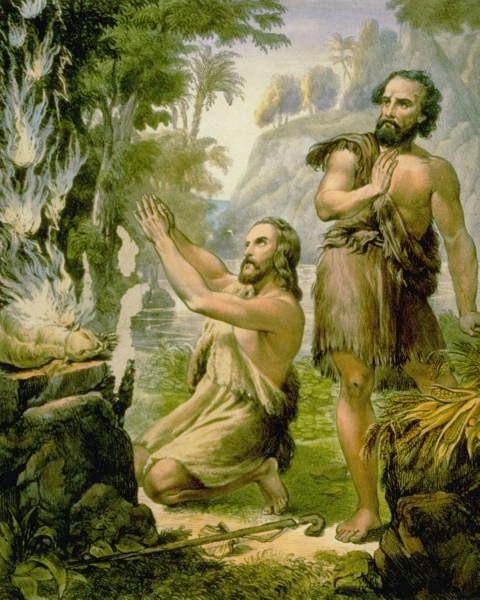
East of Eden XLIII -- chpt43: ABEL'S SACRIFICE

Reading Questions
Chapter 43.1
  1. File:Cain and Abel.jpgTwo chapters ago, we saw Cal's sacrifice to his father; now we see Aron's, and while we later see Aron's typically teenager "he wouldn't understand," why is it really that he doesn't want to tell his father?  Additionally, compare Aron's feelings for his father with Adam's feelings for his father (or Charles's for that matter).  There's an interestingly mirrored parallel there.
  2. Is lack of ambition, like Lee's, a blessing or a curse?  (Consider this in and out of context.)  In Lee's case, how does it perfectly serve him as arbiter for this odd family?

Chapter 43.2
  1. Would knowing Mary Magdalene were his mother make it any easier for Aron to forgive her?  What should this reveal to him about his ambition for the Cloth, and why will he not--at least not now--recognize such a revelation?

Chapter 43.3
  1. Interestingly, Cal's "sacrifice" is as vegetable as was Cain's.  How might Aron's be indeed considered the animal sacrifice of the Old Testament, especially considering Abel's sacrifice was of the firstlings and of the fat, or the best, thereof?
  2. Why does Lee keep bringing up von Clausewitz?
  3. Aron is guilty of the greatest misconception of all of humanity, regarding the color of grass and fences.  I'm surprised Lee doesn't spend more than a sentence pointing this out, instead he opens up a pontificating #10 can of the extremes of youth.  Why doesn't he know--or chooses to ignore that--this won't do a lick of good?

Thursday, October 28, 2010

East of Eden XXIII -- chpt22: BAPTISM, minus the water

Reading Questions
Chapter 22.1

  1. I can't help but think of couples who lose a child, which loss destroys their relationship, overcoming the love they have for each other, such that they can't find it--if it even continues to exist (is such a thing terminable? I think so).  Is Adam experiencing something like this or, as its his spouse and his children remain, is it entirely different?
  2. What does it mean that "Adam might be pleasuring himself with sadness"?
  3. It is interesting, the magic Samuel works on those around him: Lee is the prime example.  Notice how Lee's walls and masks simply slack from him when no one else is around.  It is the same, to a degree, with his children.  People are more themselves around Samuel (of course, this seems only to be the case for those who have something to hide behind: Liza is entirely bald and naked with or without him).  Does this eventually--as it hasn't until this point--work on Adam?  Is the "shocking" he's setting out to perform a bit of his wife creeping into his person?

Chapter 22.2

  1. Does Liza think it's important that the boys have names at this point?  It would seem to me that perhaps she doesn't, at least inasmuch as it isn't her or anybody else's business.  If this is the case however, why does she say, quite clearly, "If you do not get those boys names, there'll be no warm place in this house for you.  Don't you dare come whining back, saying he wouldn't do it or he wouldn't listen.  If you do I'll have to go myself"?  (And she smiles when she aggravates him to shouting!  WHY!?)
  2. What a beautifully self-contradictory woman!  Does she bring out--or provoke--the best in Samuel as a spouse should?

Chapter 22.3

  1. Ah!  The words of a hero (I think I will have this written on my grave): "A man, his whole life, matches himself against pay.  And how, if it's my whole life's work to find my worth, can you, sad man, write me down instant in a ledger?"  (Oh, it makes my heart sing!)
  2. Liza says it herself, that her husband's words are honey--poetry, true--Steinbeck's own, like some of the richest descriptive passages from Tortilla Flat (my pet favorite of the man's): "In a bitter night, a mustard night that was last night, a good thought came and the dark was sweetened when the day sat down.  And this thought went from evening star to the late dipper on the edge of the first light--that our betters spoke of.  So I invite myself."
  3. And Samuel's righteous indignation like the mighty wrath of a prophet for his God!  "Tear away with your jelly fingers.  You have not bought these boys, nor stolen them, nor passed any bit for them.  You have them by some strange and lovely dispensation....  The stone orchard celebrates too little, not too much."
  4. And Adam's defense (is it valid--really, is it!?): "What I do [or don't do] is my own business" speaking of his not having "laid a number" to his sons.
  5. And imagine the force of the stubborn old farmer's fist on the heathen's jaw!  I met a farmer in Italy once.  I've always thought of this particular gentle giant when I've read this passage from the book.  The man towered over me, pushing seven feet, with bones too big for his skin.  I don't have small hands, but when he took mine in his for a handshake, my little paw DISAPPEARED TO ABOVE MY WRIST.  I picture a fist like this--literal or figurative with its godly power--crashing into Adam's listless face.
  6. How are the boys naked without names?  They're still only babies.  With what exactly--more than one thing--will they be clothed once the names, with Adam's help and approval, are chosen and assigned?
  7. Proof of Samuel's success?  "It's hard to imagine I'd thank a man for insults and for me out like a rug.  But I'm grateful.  It's a hurty thanks, but it's thanks."
  8. Why do we need to sort out emotion--to label them as loss or hate or loneliness or whatever?  How will alleviating this confusion of labels help Adam ascend from his dearth?
  9. A point regarding NATURE vs NURTURE: "And I will warn you now that not their blood but your suspicion might build evil in them.  They will be what you expect them to be.  ...  I don't very much believe in blood.  I think when a man finds good or bad in his children he is seeing only what he planted in them after they cleared the womb." //  From Adam: "You can't make a race horse of a pig." //  From Samuel: "No, but you can make a very fast pig."  Interesting, as this makes sense coming from Samuel, who's raised to adulthood a huge family, but not so much coming from Steinbeck, who, at the time, has only two young boys, and he's not even the one really raising them!  What do you think?  (Ad astra per alia porci.)
  10. I repeat a question from before: Whose children are these boys?
  11. "I'd think there are degree of greatness," Adam said.  //  "I don't think so," said Samuel.  "That would be like saying there is a little bigness."
  12. Twice in this section, Samuel refers indirectly to Jesus Christ.  Once, regarding himself to be inherently too mediocre and cowardly to face crucifixion, and second, in Lee's position as a servant and a likely greater man than he or Adam will ever be.

Chapter 22.4

  1. Wise Lee, regarding the negative connotation of the name, Cain, and that it's perhaps never been borne since: "Maybe that's why the name has never changed its emphasis."
  2. How patient Steinbeck is as an author.  There's no rushing into the naming.  He's got something important in common with his Cathy Ames.  The moment comes as and when it will, and in the meantime he waits and takes advantage of the available moments for his further advantage.
  3. "No story has power, nor will it last, unless we feel in ourselves that it is true and true of us."  What stories do you know and/or have read that, by this standard, are true?
  4. Adam displays a personal moment of hope--of self-hope: "Well, every little boy thinks he invented sin.  Virtue we think we learn, because we are told about it.  But sin is our own designing."  Yet is is also tinged with hopelessness, and with it, MASSIVE foreshadowing for both event and theme: "Because we are descended from this.  This is our father.  Some of our guilt is absorbed in our ancestry.  What chance did we have?  We are the children of our father.  It means we aren't the first.  It's an excuse, and there aren't enough excused in the world."
  5. Does Adam have any inclination--even akin to deja vous--that as he defends Cain he defends his brother?
  6. Samuel: "I think this is the best-known story in the world because it is everybody' story."  (This, by the way, is the essence of the definition of Myth--not myth=fiction, but myth=foundational literature and history, true or not.)
  7. "But [Aaron] didn't make it to the Promised Land."
  8. Why does Samuel tear up in the final paragraph?

Monday, October 18, 2010

Podcast #3 -- "TALENTS" (or, in this case, "LAND") (and it's short!)

I wasn't planning on this, and maybe it makes no sense.  Maybe it was my subconscious working in an attempt to make up for the ridiculously convoluted stream of random ideas I presented yesterday.  This one, I think, works and is maybe even more applicable.  AND IT'S SHORT!  (I know; I said that already.)


I didn't get into the details of the parable from Matthew (chapter 25, by the way, if you're interested), but there's a lot more we could talk about.  Call it the Atonement of Jesus Christ.  Call it Karma.  Whatever.  Regardless of whatever you choose to call it, though, and if you believe this stuff from one side or another, well, then, how comforting!  (And this is one of the greatest things about literature, with or without religion tacked to it: it applies to real life!)  Maybe God didn't give me much, but as long as I do my best with it, well, maybe He'll take me in when It's all over after all. 

Cheers!
Related Posts Plugin for WordPress, Blogger...