* NOTICE: Mr. Center's Wall is on indefinite hiatus. Got something to say about it? Click HERE and type.
Showing posts with label review. Show all posts

Friday, November 19, 2010

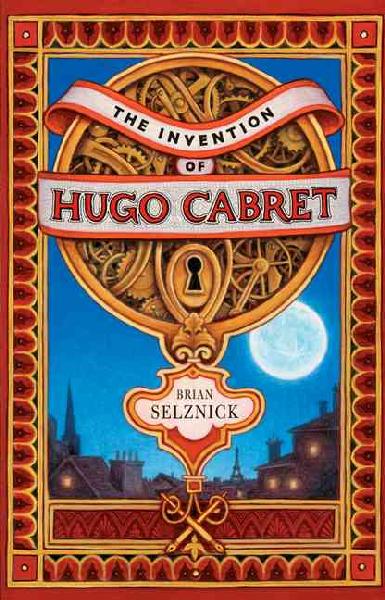
The Invention of HUGO CABRET

I am consistently amazed by how much my wife and my son are alike.  Sometimes I think my son and I have nothing in common.  He likes action figures.  He likes comic books.  He's got a super-hero complex.  The only reason he likes Legos is to play with the final product--nothing to do with the joy of building.  I liked to draw.  He likes to color.  I play the drums.  He prefers to sing (or his version of singing, and only themes from Star Wars, Indiana Jones, Iron Man, etcetera).  How great it was then when my sister came along for a visit over the weekend of my brother's wedding and dropped off, "for you and Jacob to read together," she said, The Invention of Hugo Cabret, by Brian Selznick.  Jacob and I both sunk our teeth into it, and, for us, devoured it in near record time (about five sittings of an hour or so each).

The story is that of Hugo Cabret (duh), adolescent time-keeper and local thief, clandestine both, for a train station in Paris.  An inventor he is, which talent he inherited from his dead father, which he maintains through repair work on a discovered magician's automaton, which subsequently, he believes, will reveal some final words of wisdom or life-answers from his father; the automaton was originally discovered by his father, who began its repair and left it to Hugo upon his death.

As Hugo, via parts stolen from a train station toy shop, finalizes the repairs on the automaton, the book starts weaving into its plot the early history of cinema, which becomes the primary subject of the book, and the hook of its mystery.

The things most attractive to my boy: the fantastic illustrations, blended with stills from old movies, but mostly the action and mystery.  The story is great for the action and mystery.  He loved it.  I loved.

The things I liked best: the same.  And the early cinema history was really cool, too.  (Woo-hoo!  Something in common!)

Two thumbs up from each of us.

As far as the old movies go, check out Georges Melies, and his most famous flick, A Trip to the Moon.  Even after all the adventure and intrigue of the read, the culminating moment for Jacob and me, and here my daughter joined us, and with slightly more fervor than for the actual reaing (though she did like the pictures), came after having finished the book.  We found A Trip to the Moon on youtube.  (And I never thought I'd say this:) heaven bless the youtube!


Saturday, November 6, 2010

Movie Review: DESPICABLE ME


Birthdays finished.  We rounded out the humongous weekend with a trip to the local second-run theatre to see Despicable Me.  My wife hates animated features, except Toy Story, though I did hear her laughing here and there throughout the feature.  She liked the story of the three little kittens.  I like the story of the unicorn.

So here's the review, in four single-word sentences, as uttered by my son upon standing up to put on our jackets after it finished:

"Uh.  That.  Was.  Weird."

Saturday, October 23, 2010

Poetess, PHILLIS WHEATLEY (named for her slave ship and her uncommonly beneficent masters)

I've got the chronic problem of reading too many books at any one time.  I'm currently reading--one story at a time and only irregularly--Fictions, by JL Borges, The Invention of Hugo Cabret, with my kids, by Brian Selznick, All the Pretty Horses, by Cormac McCarthy, and now, one I just picked up at the library where we went in effort to escape the duldrums of a rainy day and restless, over-tired kids, Phillis Wheatley, Complete Writings.

Apparently the source of quite a bit of scholarly writing, Wheatley was a prodigy in many ways.  I'm not going to bore you with it all here, but leave it at this for now: her first published works were vouched as legitimately penned by her by a collection of important Boston white guys for three reasons: she was black, she was young, and she was a she--and all this coupled with the fact that there was no precedent for her!  She is the first published black woman. 

I haven't gotten very far, maybe fifteen pieces or so and just now skimmed and need to reread a lengthy account of David and Goliath, but here is a stanza that I'm quite partial to already, "Thoughts on the WORKS of PROVIDENCE:"

ARISE, my soul, on wings enraptur'd, rise
To praise the monarch of the earth and skies,
Whose goodness and beneficence appear
As round its centre moves the rolling year,
Or when the morning glows with rosy charms,
Or the sun slumbers in the ocean's arms:
Of light divine be a rich portion lent
To guide my soul, and favour my intent.
Celestial muse, my arduous flight sustain,
And raise my mind to a seraphic strain!

I'm not often into longer poetry--and maybe it's a combination of mood an day--but it's striking me warmly.  So, I recommend Phillis Wheatley. 

Tuesday, October 19, 2010

Book Review #2: MOCKINGJAY

Have you ever heard someone say that they just finished reading a book--a book you've also read and happened to have enjoyed--and complained about what a disappointment it was, and you wonder, "Was he even reading the same book?"  Well, keep that in mind.  I'm coming back to it.

I hopped on the Hunger Games bandwagon over the summer, when Wal-Mart finally picked up the first book, which I could buy on the cheap.  Until then, my wife and I had our names on the waiting list at the local library.  (We're still not halfway through that list!)  We each read the first.  We each loved it.  It was exciting and almost new to read a writer who, first, didn't pull any punches (and if you haven't read these, really, she "keeps it real") and, two, kept it direct and simple.  This is a big deal for a someone like me who admittedly and happily loves prolixity--if it's done well, at least.  As it turns out (and such is more than certainly the case with McCarthy's The Road, by the way) that if not terse, then laconic, is just as good.  This is especially the case here, when it would be entirely out of character for the protagonist, Katniss Everdeen, to wax poetic. 

The second book made it to the mega-store as well, and we read it with similar abandon.  It too was great and fun and shocking and does what any good second-in-a-trilogy should do: it propels on from the first, and prepares with excellent cliffhanger for the third; and it can almost stand alone.

The third book, Mockingjay, came along.  We'd awaited it eagerly.  But we'd also just lost our job.  We couldn't get it.  And we couldn't get it.  Wal-Mart got it, and still we couldn't get it.  (Twice, I almost forewent milk and gas to get it, but I didn't.)  My sister-in-law got it.  Borrowed it from a friend.  It's on second-hand loan to us, and I finished it last night.

As it's been quite some time since it's come out (well, a couple months, I guess), I've heard a lot of reactions to the close of the story.  Mostly I've just heard, "What a disappointment!"  As I plugged along the first half of the book, I began to agree!  It was a little slow; not really Collins' style.  But that's it!  There was a lot of exposition that needed to happen--yes, NEEDED.  I had faith, though, in Collins, and stuck with it.  (I would have anyway; I couldn't wait to find out what the end was actually going to be!  How would the rebels win; whom would Katniss choose; would one of the selection even return to sanity; and what about the long-distant duel of the psycho presidents?)  So I finished, and I wondered, "What book did all those other people read, because it couldn't have been this one!  That ending was AMAZING!"

An inspiration, in fact, such that again I jealously thought, "Crap, I want to create something beautiful and brilliant!"  (Maybe someday.)

I think the problem people have with reading something like this is their inability to separate what they want to happen with what should, or simply DOES, happen.  It's not about what you want!  I'm guessing that most of them are sad/mad that quite a few favorite characters simply don't make it.  But isn't that how war is?  I'm sorry, but put a group of people on the front line of a war and chances are that most of them, if not all, are going to kick the bucket.  Yet there's courage and heroism and tragedy and revenge and anger and relief and, in the end, justice and recovery.  The good guys win.  (That's not really a spoiler, because that's not really what it's about.)  But does Katniss win?  She's the protagonist.  This is her story.  It's not her sister's, or old friend's, or the districts', or the other recruits'; it's hers.  Period.  And how beautifully and perfectly--and, if this story were real, how likely--Collins draws it all together.

While I'm not comparing Collins in any other way to this particular book, in one aspect in particular she draws direct comparison to one of my favorites, Catcher in the Rye.  Salinger runs the entire book through with the string of a song.  That song is a metaphor for everything that happens in the story, and particularly to the central conflict of the protagonist.  So it happens here in Mockingjay.  Collins pens really a beautiful "song," which is much more poem than anything else, and does for her story what "Catcher in the Rye" (the song) does for Salinger's.  If for no other reason, read the book for "The Hanging Tree" and what it does for the book and its characters.

In the end, everyone, ignore the freaking nay-sayers.  Read this book.  It's wonderful, and will have (once I can buy my own copy, at least) a permanent spot on my book shelf, somewhere between Chabon and Dickens.

Tuesday, October 5, 2010

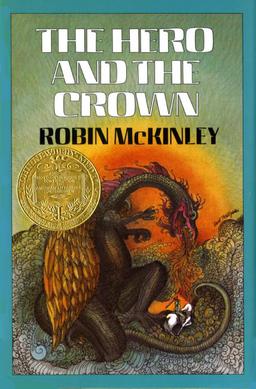
Book Review: The Hero and the Crown, Robin McKinley

File:The Hero and the Crown.jpgI'm going to try and keep this short:

I didn't like it.

I'm not sure why I really stuck with it, except there wasn't another book in the bathroom.  Well, that, and maybe since it's going to be a long time before I can buy another book (this was the most recent new-book purchase).  Maybe it's the fact that it won the Newberry back in 1985.  I don't know.  I read it. 

And I'm not sorry.  Not really.  I guess I was even kind of glad once I FINALLY got to the end, because at least then I understood how it got the Newberry. 

For of those of you who might not know, the Newberry is (by assertion of the inscription on the awarded medal), "awarded annually by the Children's Librarians Section of the American Library Association for the most distinguished contribution to American literature for children."  (Yeah, they cram all that onto the award.)  And generally I really like Newberry winners.

I hate to say it, I think this particular book only won because it's a great ("great" as in big or thorough) example of girl power, and that in a fantasy no less, a genre dominated, of course, by boys.

I've mentioned previously my problems with the book: IT'S BORING!  Granted, a book doesn't have to be riveting to be good, but it's very genre dictates the contrary!  There is a such a dire detachment between narration, characters, and reader....  The whole thing feels entirely passive and, well, so-what-ish.  And that the author even feels that way.  Additionally, and this is fault of so many fantasies, it seems to be trying to be a new Lord of the Rings.  The chick version.  And I don't have any problem with LOR, and I don't have any problem with chick lit, and even less with books that feature strong girls and women.  I'm all for it.  But I think this book actually worked against the very issue it was trying to support by doing it poorly!

Maybe it was the impolite fumes....  Maybe if I'd sat in my perfectly fragrant leather chair--so soft, comfortable, and adept at eliciting inducements of thought and imagery--I'd have sunk a little more deeply and, if not consistently, at least sympathetically, into the story.

And not that there's nothing redemptive about it.  There are lots of people like it.  I'm just not one of them.

Saturday, September 25, 2010

The Social Network

Some movies are as good as books.  Some previews--the anticipation--are as good as waiting for the next Chabon, HP, or (for me and my periodic, requisite popcorn fix) Lincoln/Child-Pendergast.

With the possible exception (though only in certain aspects) of Panic Room, David Fincher hasn't made a bad movie.  Some of his movies are revelations, and The Curious Case of Benjamin Button is one of my all-time favorites.  How could I not be excited about his new one, The Social Network.

Check out THE review:
http://blogs.indiewire.com/toddmccarthy/archives/2010/09/20/review_the_social_network

Check out the trailers:
http://trailers.apple.com/trailers/sony_pictures/thesocialnetwork/

Thursday, September 23, 2010

Book Recommendation #1

I hope to make many such recommendations as time goes on, and here is the first.

In a recent facebook post (within five minutes of writing these very words, as it so happens), I used the phrase "beat around the bush."  Just as I find etymology intriguing, so I find the derivation of common phrases (is there a word for that? --Devin?).  So I googled it.  Pshaw.  A million listings (well, 81300).

Then I remembered a truly excellent book given me by my father for my birthday this past summer:

Brewer's Dictionary of Phrase and Fable

The name alone should indicate this thing should be great, and I refer you to www.bn.com to check it out:


The only problem so far, is that I'm not used to having this wonderful resource, but I'm getting there.  Each time I use it, I'm more grateful I've got it, and, hopefully, that much more likely to remember it the next time I think I need to google something.

So back to the phrase.  This is Brewer's description under the heading "Beat," subheading, "Beat about the bush, to:"

Beat (Old English beatan).  The first sense of the word was that of striking.  That of overcoming or defeating developed from this.  As a noun, a beat is a track, range or walk, trodden or beaten by the feet, as the 'beat of a policeman'.

Beat about the bush, To.  To approach a matter cautiously, in a roundabout way; to SHILLY-SHALLY.  The reference is probably to the hunting of birds by night when they are resting or roosting.  The bushes are beaten, the birds are disturbed and fly out, and they are then netted or stunned as they try to escape.

What I love is how concise it is, and that you can look up practically anything.  While someone who is particular about what they find, the book might prove disappointing.  It doesn't have "practically" everything.  I lied.  Practically speaking, it has a wide assortment, but this actually acts to improve its value.  While you sit there and twiddle through the pages wondering if they must have put your chosen word, phrase, or fable in the wrong spot (as you've all done with a dictionary at least once in your lives), you will find three, four, or fifteen items that you were definitely not looking for but you're glad you found.  Brilliant!

To give you an idea, here is a list (without accompanying descriptions/definitions) of the other words just under the main heading "beat:"

Beat about, To; Beat about the bush, To; Beat an alarm, To; Beat a retreat, To; Beat down, to; Beaten at the post; Beat Generation, The; Beat it, To; Beat one's breast, To; Beat retreat, To; Beat someone hollow, To; Beat someone's brains out, To; Beat the air, To; Beat the band, To; Beat the bounds, To; Beat the bush while another takes the bird, To; Beat the clock, To; Beat the Devil's tattoo, To; Beat the drum for, To; Beat the Dutch, to; Beat time, To; Beat up, To; Can you beat it? Dead beat; It beats me; Not in my beat; That beats Banagher

If you've got an ounce of curiosity in you, you've got to be wondering what in the world could possibly be said about some of these.  I am!  What in the world does "That beats Banagher" mean?  (You might like to know--and this actually explains a lot--that this is a Brittish publication.)

So check it out.  Get a used copy at amazon or something.  This is the most fun I've had with a book since....  Well, I don't know.  This is a fun book.
Related Posts Plugin for WordPress, Blogger...