* NOTICE: Mr. Center's Wall is on indefinite hiatus. Got something to say about it? Click HERE and type.
Showing posts with label death. Show all posts

Sunday, December 11, 2011

Sunday Poetry XLII -- Never the Same Twice :: Lisel Mueller

“  When I am asked
    how I began writing poems,
    I talk about the indifference of nature.  ”

Alone, these words are fantastic.  Right?  Brilliant.  Sure.  Genius?  …

(See?  I’ve got this thing with “genius,” going back, as far as I can tell, to the day I learned my dad prayed that none of his kids would be one.  (Dad:  prayer answered.)  I guess I bring it up again because there seems to be this indelible connection between the definition—at least in practice—of genius and that of art—art being, or any work thereof, as difficult to define as genius is to identify or, maybe more so, explain.)

…  But it’s the rest of the poem that brings this thing really around to make a glorious connection I didn’t anticipate.  Perhaps it’s this convergence—or the millions just like it that happen all over the world all the time—that drew me in and bubbled up that word—“genius”—again from its little locker back there.

Here’s the poem:

When I am Asked
by Lisel Mueller – Pulitzer Prize winner, 1996

When I am asked
how I began writing poems,
I talk about the indifference of nature.

It was soon after my mother died,
a brilliant June day,
everything blooming.

I sat on a gray stone bench
in a lovingly planted garden,
but the day lilies were as deaf
as the ears of drunken sleepers
and the roses curved inward.
Nothing was black or unbroken
and not a leaf fell
and the sun blared endless commercials
for summer holidays.

I sat on a gray stone bench
ringed with the ingenue faces
of pink and white impatiens
and placed my grief
in the mouth of language,
the only thing that would grieve with me.

It’s those last three lines, right? —that metaphysical power of words—particularly for those who know how, even a little, to really use them?

So I picked out the book, Mueller’s Alive Together, just an hour or so ago from a box of my books I picked out from a mountain of them out in my garage.  (I think this is the benefit of having sold all my bookshelves: I can’t just pick out all the same old books because I have no idea where they are.)  This is another of the books I inherited back at the Saginaw Arts and Sciences Academy from my predecessor.  Unlike the others, this one is full of that teacher's annotations.  Normally, this would bother me, particularly as I’m generally so averse to writing in books that it took me three-quarters of a semester before I started highlighting my law books.

Anyway, by way of the poem above, the experience of reading by way of another reader’s reading, and an interesting thing I heard at church this morning—remarkably apropos—I think I’m a step closer to understanding the confluence of genius in art (if nowhere else).

Hugh Nibley, a once religious studies and linguistics professor at Brigham Young University, was the source of the quotation that caught my attention.  I don’t have the quotation in front of me, nor have I found it online, but here’s the gist of it:  That scripture isn’t the words before us, penned by the prophets, but the experience of reading those words.

That’s pretty big, particularly religiously—well, if you’re one who happens to read scripture, anyway—but nearly as much so for the reader of literature, the viewer of art, and, most approachably, the listener of music.  When I’m trying to pin down why it is I think a certain work, or a certain artist, is genius, it usually begins with not the substance of the art itself, but the ineffable experience that blooms or emerges or ka-pows right there in that intangible space somewhere between my senses and the work.  Even afterward, trying to rationalize it, trying to objectify it, remove that emotional response, I can never separate myself from that initial experience, which brings me to the next of the poems from Mueller:

A Farewell, A Welcome
               After the lunar landings
Good-bye pale cold inconstant
tease, you never existed
therefore we had to invent you

               Good-bye crooked little man
               huntress who sleeps alone
               dear pastor, shepherd of the stars
               who tucked us in               Good-bye

Good riddance phony prop
con man moon
who tap-danced with June
to the tender surrender
of love from above

Good-bye decanter of magic liquids
fortuneteller par excellence
seduce  incubus medicine man
exiles’ sanity       love’s sealed lips
womb that nourished the monstrous child
and the sweet ripe grain Good-bye
               We trade you in as we traded
               the evil eye for the virus
               the rose seat of affections
               for the indispensbile pump
we say good-bye as we said good-bye
to angels in nightgowns                 to Grandfather God

Good-bye forever Edam and Gorgonzola
cantaloupe in the sky
night watchman, one-eyed loner
wolves nevertheless
Aae programmed to howl             Good-bye
               forbidden lover good-bye
               sleepwalkers will wander
               with outstretched arms for no reason
               while you continue routinely
               to husband the seal, prevail
               in the fix of infant strabismus
good-bye ripe ovum        women will spill their blood
in spite of you now          lunatics wave good-bye
accepting despair by another name

Welcome new world to the brave old words
peace    Hope     Justice
truth Everylasting             welcome
ash-colored playground of children
happy in air bags
never to touch is never to miss it

Scarface hellow we’ve got you covered
welcome untouchable     outlaw
with an alias in every country
salvos and roses               you are home
our footprints stamp you mortal

***

I was going to put up one more of her poems (this one inspired by Martin Gardner, no less!), but I think I’ll leave it here.  

Sunday, August 28, 2011

Sunday Poetry XL -- "The Third Coast," 1979


There is no more sure-fire way to ensure the "datedness" of a book than subtitling it, in part, with the word "contemporary," in this case, "Contemporary Michigan Poetry," another book, very much like You've Been Told, from a couple weeks ago, that I have (didn't buy, but inherited) but haven't read.  So, today, I will peruse the collection and, in real time, randomly choose three poems.  Here they are, contemporary or not, in all the glory (your thoughts are welcome):

Death and the Pineapple
Dan Gerber, pp 57-58
The fruit itself a giant pinecone
Texture of an apple     the taste
An apple flavored with pine
If I died I couldn’t eat pineapples
Couldn’t slice them with a large knife
Or say the word that conjures the taste
Pie-napple     pine-apple
Couldn’t run my hands
Down the rough sides
Or over the bushy top
Let its juice drizzle down my chin
Or wipe it away
With the back of my hand
Rub it in my hair     gargle it
Ponder the origin of its name
Throw it at a strange and beautiful
Woman on the rue Saint-Jacques
Imagine a trip to Hawaii

The pineapple
Is what we give up when we die
Along with strawberries     coffee and sun
The room hovers about me
One more skull
The trees around the house
The sky around the tree
The stars around the sky
How could I escape so many enclosures
What would I see
What tastes     what sins
And if existence exists in space
What space     I can’t imagine nothing

A house I once visited
Had a pineapple over the door
A pineapple over the newel post
A pineapple in the center of the table
Surely these people had lived
They said it was their family crest
My sign     my life
A galaxy of pineapples

I considered all the pineapples
Growing under the sun
And will enjoy the good of my labor
All the days of my pineapple
For there is a wicked man
Who prolongeth his pineapple
In his wickedness
And not a just man on earth
That doeth good and sinneth not

In the Winter of Tigers
Tom McKeown, p150
In the winter of tigers,
After the zoo closes, the sun
Smokes and thins out, seeds
Leap from an apple’s core,
Wheat whispers loudly
To the earth, to startled snow.

A crow plummets
Through the calm sky
Like a black parachute
That never opens.

In the middle of winter, the tigers
Walk up the snowy mountains
And spread out with the snow,
Until there is only snow and tigers,
And the memories of tigers,
Invisible against the snow.

At St. Mary’s for the Aged
Eve Shelnutt, p235
She thinks God wants a wife.
She would like to lie with Him.
Would He make her pretty,
Or take her as she is?
Where, around Him, do the arms go?

The jealous Sisters see her rise;
Their hands cross on the door.
She dies and, dead,
Is not denied.
The Sisters lifting bones
Are satisfied.

Tuesday, February 22, 2011

The Riddle of the Traveling Skull -- EXCERPT

I am deliberately reading this book slowly, because it's just such a stinking good read--ridiculous fun (and you can take that to pretty much accurately call any connotation you want: ridiculous, truly; and fun).  I don't know where I'm going to find more Keeler when this one's over, though.  This is a limited edition; all the rest are out of print!

Here, 3 tombstones from and a cabbie's description of a red-herring cemetery:

Here lies the famous
O MING LEE
The Girl with Four Legs and Six Arms
Known to the Profession
as
LEGGA, THE HUMAN SPIDER
Born Canton, China          Died Canton, Ohio
1917 - 1937
Erected by the Chinese of America

*

b. 1884 d. 1936
Here lies
GEN. TOM DOWLING
18 inches high
20 pounds in weight
Rest in peace, General!

*

ROSCOE PARKER
He brought happiness and
cheer to the world, with
a heart that, for sheer
nobleness, conformed with
his 612 pounds of weight!
B. 1885 D. 1935


“Well, it’s the cem’tery f’r circus an’ carnival people.  And been there about—I guess—four years now.”  He was turning the cab about in the width of the narrow crosswise street, but went on talking just the same.  “Far more people goes out to see the place, though, out o’ curiosity, than to see their dead ‘uns.  ‘Specially since it got wrote up in the newspaper.  They go out to read th’ cur’ous tombstones.  For they’s one or two o’ every kind o’ person buried there.  A midget or two—an’—an’ a giant, to boot!  An’ a fire-eater—he’s in the northeast corner—his tombstone says ‘If Hell There Be, He Hath No Fear of It.’  And there’s a couple o’ sword-swallowers.  One of ‘em’s grave hasn’t no stone nor nothing—but is set off, all around, with the swords he used in his act—all rusty now, o’ course.  And there’s a fat man—and a fat lady, too, somew’eres.  And the oldest tent-stake driver in the country—Jed Hopkins—forty years with Ringlings and Barnums—is in another corner.  And there’s two—no—three trapeze queens.  They don’t live long, y’ know.  They allus bust their necks!  And there’s a rubber-skinned man too.  Oh—there’s a little o’ everything in that place, I guess.” . . .  “They say,” he went on, “that half o’ th’ people in circuses and carnivals ‘d ruther be buried there than—than planted with their own folks.  In fac’, lots has been transferred there from older cem’teries.  And—but say—you didn’t know what the place was, eh?  Did—did someone hang somethin’ on you?”

Wednesday, February 9, 2011

Alice in Wonderland II -- chapter 1: ALL IN A GOLDEN AFTERNOON

  1. Carroll is endlessly crafty.  What hidden references to the Liddell sisters ("Liddell" pronounced with first-syllable emphasis) do you find in the poem?  (Of the three girls mentioned in the opening poem, which is a fair account of the story's genesis on July 4, allegedly, Prima, Secunda, and Tertia, the second is Alice.)  Additionally, and I expect some of his metaphysical humor rubbed of on his friends, it is the girls who claimed, and rightfully so, "It is next time!"  Isn't it always "next time"?
  2. Alice was Carroll's favorite.  I believe it's fair to say the preference came from a mutual affinity in personality: "...what is the use of a book without pictures or conversations?" seems to indicate Carroll's preference, especially as such a preference is justified across these and his other fantastical works.
  3. The fantasy of Alice reaches beyond the rabbit hole.  How so, and to what significance (I'm thinking of this as further indication of traits and preferences of Carroll, rather than Alice)?
  4. Perhaps surprisingly, death is a frequent visitor in Alice, and generally in the form of very dark humor.  Can you spot any in this first chapter (I've got 2)?  More importantly, and generally skipped, why the death jokes at all?
  5. Remember the cat, Dinah (one of two cats of the Liddells'), and her kittens for later.
  6. The garden through the little door (with the possible addition of the key) is, as far as I'm concerned, one of the most important metaphors in the book.  T.S. Eliot interpreted the garden as "a metaphor for events that might have been, had one opened certain doors" (The Annotated Alice, p16, note7).  I have reason to believe, which I will be expound upon when we read Looking Glass (particularly in the forest with no names) that this is more of an allusion to Eden; though in this case, I think the two interpretations are easily reconciled.  Thoughts?
  7. "Alice had begun to think that very few things indeed were really impossible."  This, in context of the garden, I think, is a very optimistic statement.  But what are the implications that the impossible--and this particular impossibility regarding the garden--is only superable in Wonderland (apply also to #3)?
  8. WARNING: potential over-analysis -- Here is the first moment when I believe Carroll makes a personal appearance (the first of many) in the setting of the story, unbeknownst to Alice; these events evince a sort of meta-story only ever apparent (though never fully realized) between the lines.  This appearance (though can it be an "appearance" if we, whose eyes are Alice's eyes, don't "see" him?)  is particularly anonymous, and demonstrates a keen understanding of children and their attentions.  For many children, there is essentially nothing beyond their immediate focus.  The world could crumble and, if they were adequately drawn to another point, they would not notice.  So, then, where does the bottle come from and why?  How might, if at all (highly speculative, but I feel justified by my general understanding of the books), this relate to the garden?
  9. "Nice little stories."
  10. There are 12 changes of physical size that Alice undergoes throughout the books.  Is there something deeper than the fantasy of it?  Consider Alice Liddell's age and all the problems that go with it, at least as far as Carroll's concerned.
  11. The fact that Alice still cannot get into the garden despite her new size indicates...  what?  Is there any way for her to control her circumstances, or is her impotence due solely to her mistake (see also #3 and #8)?
  12. "...going out altogether, like a candle."
  13. Alice :: Alas -- a pun?
  14. (For future reference: Though I haven't yet read Finnegan's Wake, allegedly he alludes frequently to Alice.)
  15. Is it Alice or Carroll who likes to be two people at once--or both, i.e. in the case of the book Alice and Carroll may arguably be the same person inasmuch as twins or even reflections are the same (consider also this appearance ALICE LIDDELL :: LEWIS CARROLL)?  (Doubles are another important series of allusions, like the death jokes, the garden, etcetera.)

In defense of apparent "reading-too-much-into-it": The definable layers in Carroll's writing--jokes, allusions, puzzles, etcetera--are all fine precedent to support the possibility of other more deeply speculative bits.

Friday, January 28, 2011

Jane Eyre XXXII -- chapter 31: WHY . SO . SERIOUS ?

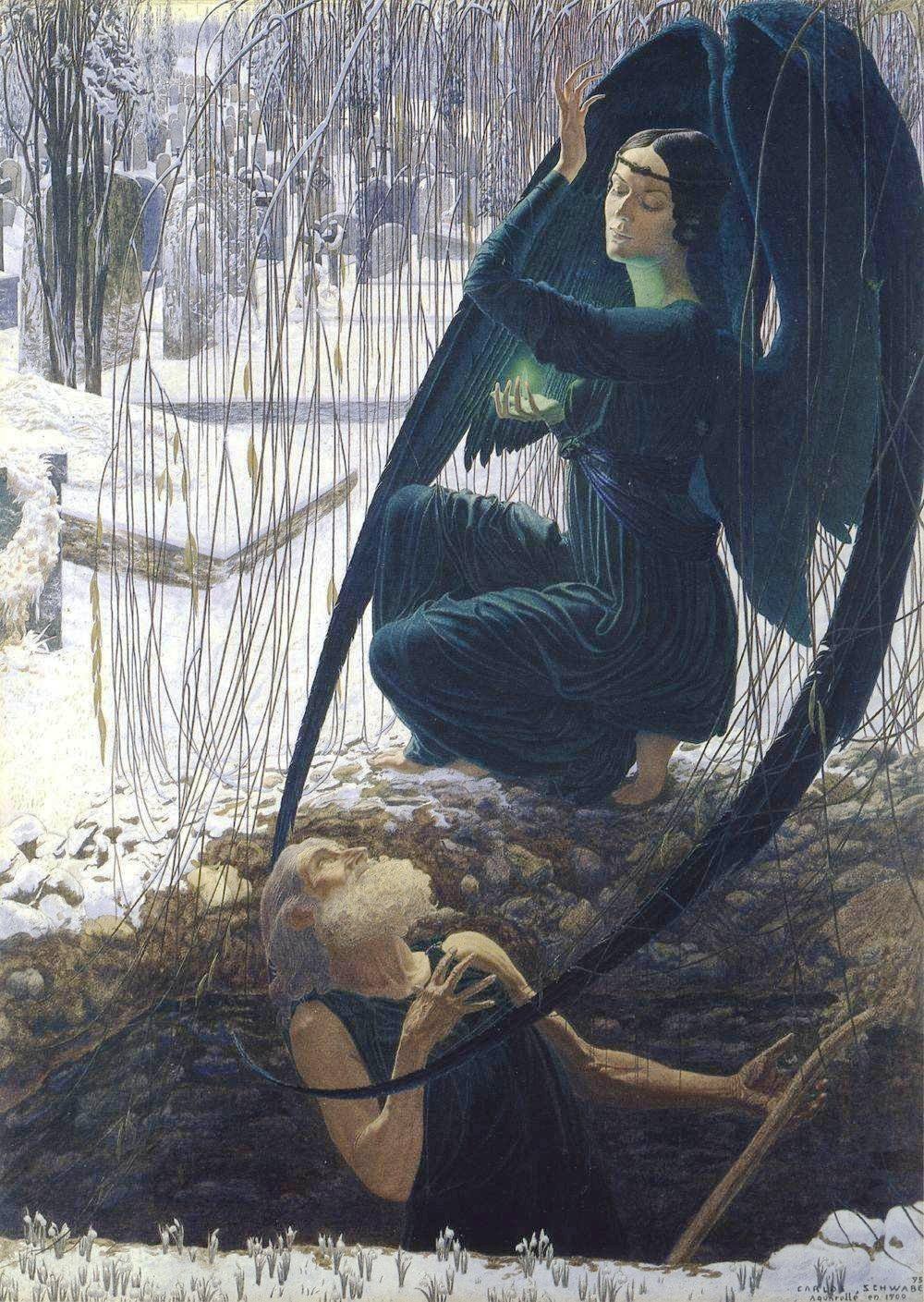
"La mort du fossoyeur," Carlos Schwabe;
(thanks wikipedia)
From Sir Walter Scott's The Lay of the Last Minstrel: canto 3, XXIV:

So pass'd the day; the evening fell,
'Twas near the time of curfew bell;
The air was mild, the wind was calm,
The stream was smooth, the dew was balm;
E'en the rude watchman on the tower
Enjoy'd and bless'd the lovely hour.
Far more fair Margaret lov'd and bless'd
The hour of silence and of rest.
On the high turret sitting lone,
She waked at times the lute's soft tone;
Touch'd a wild note, and all between
Thought of the bower of hawthorns green.
Her golden hair stream'd free from band,
Her fair cheek rested on her hand
Her blue eyes sought the west afar
For lovers love the western star.
  1. Mr. Rivers has just given Jane the rundown of his life and his abandoned ambitions, and now he's faced with this gorgeous girl and, upon offering mild reprimand for her being out and about so late, "...he crushed the snowy heads of the closed flowers with his feet."  I suspect foreshadowing, but judging by further paragraphs, the crushed flowers are for his forceful efforts to quell the love in his heart for this pretty thing cooing over both him and his dog (after all, if she can't caress him, might as well caress his dog--metonymic, it would seem).
  2. "inexorable as death" -- what a way to paint your brother!  Inexorable = grim.
*

Monday, December 27, 2010

Jane Eyre IX -- chapter 9: SPRING AND DEATH AT LOWOOD

Reading Questions
  1. It's not particularly interesting that as Jane arrived at Lowood and its initial torments, having left the long dark of Gateshead, in November when it was cold and nasty, so her life was terrible, and now that the weather is improving, so is her situation.  I say "not particularly interesting," because this sort of parallel is almost cliche nowadays, at least in the obvious nature that it's used here.  It's about as bad as the rain that falls so obsequious to mood in HP7's tent scene (book, not movie) when Ron takes off in a huff.  So the questions: 1, is it indeed cliche; 2, is there a better way to emphasize the emotions; 3, is winter really so bad; and 4, does this mean we have to wait until Fall for her life to drop back to torment again, or should we expect Spring thunderstorms and hurricanes?
  2. There's a shock to the system of cheerfulness, just a few paragraphs down from the chapter's top, with the rising of the fog: dank and deadly! as if the thaw of Spring has done little more than permit the zombies and their pestilence (flea- and louse-carriers of typhus, which very word means "foggy") to escape their icy, winter prisons.  Is the beauty of spring really no more than a bate?  Yet, ironic it is, leastway for those who've escaped the disease: life becomes even more pleasant for their increased freedom, as the teachers are all locked up with the infirm!  Blessed be those of strong constitution, and O, pity the poorly frail!  At least the dying have the comfort of a beautiful view.
  3. Is there no remorse or second thought for those not free to roam the woods?  At least Mr. Brocklehurst stays away, right?  Is Jane really so cruel?  Shouldn't she abscond to see her most valued friend earlier than she finally does?  Why does she take so much time with the callow Mary Ann?
  4. Interesting, contrary to the weather-plus-mood, that as Jane finally begins to think about the death and disease around her and its contingency of heaven and hell, she gets news of Helen's imminent death.  So what of Helen?  What might this say about Jane?
  5. Are those who die young to be envied?
  6. The melodrama of Jane Eyre reminds me of Anne of Green Gables, only, of course, darker.  (I've been trying to figure out this connection out since chapter 3--Jane is a goth Anne Shirley!)
  7. Helen has a father.  Was her little speech about him not missing her, distracted by his recent marriage, just euphemism?  After all, she's not even taken home for burial, and it's 15 years before a grave marker is placed.  And who will have placed the marker, and what's up with the idiot father?
Springtime at Lowood

Tuesday, November 16, 2010

East of Eden XXXV -- chpts34-35: BELIEVE IT OR NOT

Chapter 34


129,864,880


that's a pretty big number

I have heard a university professor of literature claim that there are but three types of stories: The Coming of Age, The Quest, and The Battle.  But if you take Scheherazade as any indication of count, then you might say there are as many as 1001 stories.  According to Google, on the other hand, there are (and I'm writing this out just for the weight of it) one hundred twenty-nine million, eight hundred sixty-four thousand, eight hundred eighty books "in the world."  It's likely that the majority of these are non-fiction, but even if, say, twenty percent represents fiction, that still leaves more than twenty-five million books, many of which will be collections of stories, not to mention all the non-fiction narratives out there.  Let's round up to fifty million stories, just to be safe, in the world.  That's a lot more than three.  That's a lot more than one, which, according to Steinbeck, is all there is.  Of course, he says that all stories boil down to a battle against evil.  Do we trust him?  We do tend to venerate the man here at the Wall.  Is his claim not true?  (...which is another way to request examples of stories that transcend the labels.)


If we look again at the three stories brought up once by that university professor, they are actually three types of stories, as is good versus evil a type of story, or narrative.  The Coming of Age is man vs. self, The Quest is man vs. nature or other natural and supernatural forces, and The Battle is man vs. man.  When it comes right down to it, any one of those twenty-five million plus stories represents one or more of these three narrative types.  Look again, and you'll see that each of these three story types is a battle against evil.

  1. "Do you not consider me lucky?"  "How can I tell?  You aren't dead yet."
  2. What are the categories for the life stories of the three deaths the narrator "remember[s] clearly"?
  3. "It seems to me that if you or I must choose between two courses of thought or action, we should remember or dying and try so to live that our death brings no pleasure to the world," and I might add: "yet pleasure to ourselves."
***

Chapter 35

There and Back Again

  • Lee is right, as he usually is.  "It's my observation that children always surprise us."  However, not all boys--children--surprise in the same way.  This, however, is not my point of contention (yes, point of contention!).  My issue is Steinbeck's portrayal of these boys as their surrogate father walks out on them (BECAUSE THAT'S WHAT HE DOES).  I know kids who would have been crushed--and I don't think I know a kid who wouldn't be--by his departure, crushed exactly as if it had been a parent who left.  I think this may be one of the only places I disagree with Steinbeck in his various philosophies of life.  In the first moments of Lee's departure, I agree with the depiction.  Yes, I can see Cal asking about tickets to the game and Aron talking about hot dogs, but in the days that follow, the loss would begin to set in, and they would feel abandoned.  Knowing what little I do about Steinbeck's life, I wonder if this is perhaps beyond his realm of experience or understanding.  Thoughts?

  • When I first read East of Eden, laying on my hide-a-bed in my realtor's basement, my family across the country waiting for the house to finalize so we could move in, I cried twice in this chapter.  I was--and it surprised me, the superlative of emotion the book brought, likely particularly so for the context of my read-- "incomparably, incredibly, overwhelmingly glad to [have Lee] home."

Monday, November 15, 2010

East of Eden XXXIV -- chpt 33: THE GREAT ACORN CONTEST, scheduled perhaps on a day particularly perfect, as it happens, for bananafish

Yes.  Pigs do eat acorns, though I don't know what that does to the flavor of their bacon.


Reading Questions
Chapter 33.1
  1. Tom and Dessie are living quietly on the ranch, each pretending that he/she is not miserable, simply for the sake of the other's conscience.  Neither ever speaks of self, and neither knows anything of the other.  What a sad way to live!  Can you be happy pretending there are no problems?  Finally it comes to head--however puny (or maybe it's gigantic, but instead of messily popping it with fingernails, they reverently sterilize a needle to lance it, but neither ever admits it was even ever there in the first place (gross analogy--sorry)) --and the each admit knowledge of the other's misery.  So what do they do?  They decide to make plans to go to Europe.  There's a trend in this book, however, that anyone wanting to travel abroad, first, never makes the trip, however well-intentioned, and second, never actually wants to go in the first place.  SO WHY PLAN OR TALK ABOUT A TRIP TO EUROPE?  What does this bespeak of the characters?  What does this bespeak of the author?
  2. As for the acorn hunt, isn't it funny how we can let ourselves be tricked into the most menial labor, if we're just offered prizes.  And maybe life isn't a rat race; maybe life is an acorn hunt.  But are we the children or the pigs?  Both?

Chapter 33.2
  1. Who commits the fatal mistake of this section?  Can Tom be blamed?

Chapter 33.3
  1. (Interesting how Tom engenders poetry from his author.)  We have the difficult gelding which Tom bought on the cheap.  But Tom is not the one trying to break the horse.  Tom is the horse, and his rider is life.  Samuel himself talked about how Tom would dig into and through things trying violently to get at their meanings and whys and wherefores.  Tom will not let life break him, even if he knows it's exactly what he needs.  It's a sacrifice he won't make, though he wouldn't be able to say what might be sacrificed.  He is so different from Will and Liza.
  2. There is also, of course, added significance taking this approach into a reading of the letter he writes next to his brother, Will, in which he claims to have been thrown and kicked in the head by this very horse.
  3. The chapter ends in a nephew's epitaph to his worthy uncle, "He was a gallant gentleman."
East of Eden was published in September of 1952.  Salinger's "A Perfect Day for Bananafish" first appeared in the The New Yorker in the January 31, 1948 issue.  It is quite likely that these two stories were even in process of their composition at the same moment.  I know this is an overly idealistic fantasy, but I can't ignore a heavy cross-textual comparison between these two pieces, in the case of the former, regarding the moment of Tom's suicide, and whatever else about his character that led, I might say even inexorably, to his final moment. 

Salinger and Steinbeck, except that their names each start with S, have practically nothing in common (that said, for better or worse, without due dilignece paid to biographies--sue me), and there's very little chance that one author influenced the other more than superficially, though I can't imagine they were unaware of each other.

If you haven't recently read "A Perfect Day for Bananafish," do so.  There are numerous copies of it online that are easier to find, though in the case of Salinger, more so than any other author (of just words) I can think of, read him from the ink and page if you can manage it.  When you're done, respond to the following prompts, at least to yourself, though your thoughts and opinions would be much welcomed in the comments' space below:
  1. Consider Seymour's tattoos and his paranoia of people staring at them, especially those on his feet.  Consider his familial relationships (it wouldn't hurt if you reread "Raise High the Roof Beam, Carpenters" as well, though it's quite a bit longer).  All the words we use--or Samuel used--to describe Tom might be used to describe Seymour Glass, and vice versa.  Using one, describe the other.  What were Tom's bananafish?  Who was his Sybil?  Who was his Muriel?
  2. While so similar, they did not kill themselves for parallel reasons.  What was the difference?
Related Posts Plugin for WordPress, Blogger...