* NOTICE: Mr. Center's Wall is on indefinite hiatus. Got something to say about it? Click HERE and type.
Showing posts with label Cathy Ames. Show all posts

Saturday, December 4, 2010

East of Eden LI -- chpt51: "Am I supposed to look after [my brother]?"

Reading Questions
chapter 51.1

  1. What part of Adam is it that cries, "Oh, my poor darling!"?  What does this lens into the man show us?
  2. What are the two comforts for Lee taken from the little stolen book?
  3. I have books that I've "stolen," much like Lee stole this book from Sam'l Hamilton.  What is the advantage to the thief from the quality of the acquisition that is theft?  How might the theft be justified, as my theft, like Lee's, is indeed known to the former owner?


chapter 51.2

  1. It is impossible, not to mention irrational, for an author to plug a movie, author, song, or other artist without a specific purpose--metaphoric, allusionary, or something along those lines.  My favorite author for such plugs is Salinger, Cather in the Rye being the most significant, and maybe the best, example.  Here, Cal is remembering leaving Kate's and his singing of the words, "There's a rose that grows in no man's land and 'tis wonderful to see--"  Obviously there's a significance to it.  Is it had by just this line, or do you require the entire lyric (complete words at end of post)?
  2. The benefit of burning the bills, like Lee's reading of Marcus Aurelius, is two-fold.  What are the benefits?
  3. "Caleb whose suffering should have its own Homer."  (Hmm.  Doesn't it?  What is the ultimate conflict and its incarnation in this epic?)
  4. Of the characters, Adam, Lee, Aron, Cal, Cathy, which is the most realistic--or, at least, the closest to a human average?
  5. "In the old lands they say of us that we go from barbarism to decadence without an intervening culture."  Is there a practical difference between the two?

THE ROSE OF NO MAN'S LAND
(Jack Caddigan / James A. Brennan)

William Thomas - 1916
Henry Burr - 1918
Charles Hart - 1919
Hugh Donovan (a.k.a. Charles Harrison) - 1919

I've seen some beautiful flowers
Grow in life's garden fair
I've spent some wonderful hours
Lost in their fragrance rare
But I have found another
Wondrous beyond compare....

There's a rose that grows in no-man's land
And it's wonderful to see
Though its sprayed with tears, it will live for years
In my garden of memory

It's the one red rose the soldier knows
It's the work of the Master's hand
'Neath the War's great curse stands a Red Cross nurse
She's the rose of no-man's land

Out in the heavenly splendour
Down to the trail of woe
God in his mercy has sent her
Fearing the World below
We call her Rose of Heaven
We've longed to love her so....

There's a rose that grows in no-man's land
And it's wonderful to see
Though its sprayed with tears, it will live for years
In my garden of memory

It's the one red rose the soldier knows
It's the work of the Master's hand
'Neath the War's great curse stands a Red Cross nurse
She's the rose of no-man's land 
Friday, December 3, 2010

East of Eden L -- chpt50: ALICE IN EVIL-LAND, LOST THROUGH THE LOOKING GLASS

Reading Questions
Chapter 50.1

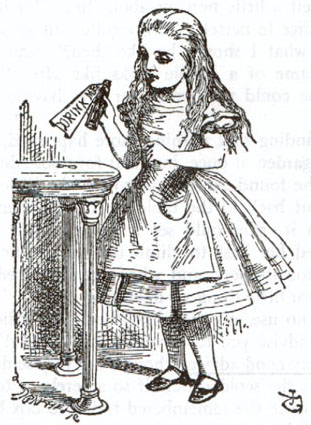
by John Tenniel
  1. Maybe Cathy could read when she was five, but she clearly missed the boat on what those words meant.  How is she like--short answer--and how is she really almost completely different than Alice in Wonderland?  (Obviously, this one's for those who've read AND UNDERSTOOD the Alice books.)
  2. How does this misinterpretation shed light on her evil--and, I'm going to pursue it still, her humanity (I believe less and less that she is indeed so inhuman and without justification as we and others have claimed)?  After all, what else in the universe does to itself what she does at the end of this section?
  3. Take a look at the very last sentence of the section;" and she had never been."  Not, "as if."  Unfortunately, it's just not true.  I think we're meant to hope so.  What legacy does she leave behind?  And regardless of how Aron responds to the news of the will (if he ever gets it), has Cathy won?  What will determine her victory?


chapter 50.2

  1. I hate to ask it, but is all this death a cop-out--a great steamroller ending?  Is this whole book thing turning all Grady-Tripp on ol' Steinbeck?  (Sorry -- for anyone following along who hasn't read Wonder Boys, Grady Tripp is a fictional creative writing professor who's working on a mammoth book with absolutely no aim to it, and which just goes and goes and goes--and goes nowhere.)

Tuesday, November 30, 2010

East of Eden XLVIII -- chpt48: **sneeze**

As a reader  you can generally tell when events are winding up--when the author's pushing things slowly toward the cliff.  Though you can't see it, but it's there.  The sensation is a little like knowing a sneeze is on its way, though perhaps you don't know how strong it will turn out or if it will fizzle to nothing (so disappointing!).  If you look closely at the writing, you can even identify the specific symptoms in the narration indicating the coming sneeze--itchy sinuses, watery eyes, sudden and involuntary snuffling up from your gut....  Here in chapter 48, I think we can begin to point out that, yes, we are about to sneeze--or East of Eden is.  How do we know?

When else has Cathy made such consistent appearances?  When else has she been so rattled for more than a paragraph at a time?  When else has someone worked directly against her?  When else has she remained so consistently agitated?

Better yet--if a mighty climax you desire--Aron's home from college, Cal's under-appreciated, and Thanksgiving is coming when Adam plans, though indirectly and with typical oblivion, to shunt Cain--I mean Cal.

Storm's a'brewin'!

Reading Questions

  1. Why does Joe feel as though maybe somebody's come in to root through his stuff?  What's the devil over shoulder on about?
  2. Is Joe's instinct against Cathy is correct, is someone--a higher power--assisting him, or is he just bumbling and lucky (unless it all turns to pot!)?
  3. Is Cathy a "soup carrier?"
  4. What's in the capsule in her necklace?
  5. Why is she inquisitive after the goings-on of the funeral?

Monday, November 29, 2010

East of Eden XLVII -- chpt47: WHO IS TO BLAME?

Reading Questions
Chapter 47.1

  1. I've noticed a version of Adam's sternness for "excuse and borderline disability" in myself and my teaching.  Though he is weak, though he hates the war and feels he's condemning the boys he sends off, why won't he accept the excuse (which is the same reason he wouldn't be able to hold back his boys)?


Chapter 47.2

  1. There's an interesting question here, which could be answered pertly, tritely, but whose answer could be much more revelatory: If God puts together two boys in a family--Cain and Abel, Charles and Adam, Cal and Aron--and one of them kills the other, even if perhaps there was reasonable doubt that they'd live well together and build each other up, is God responsible?
  2. "All great and precious things are lonely."  (I don't think I agree--or I do agree, but with exceptions.)


Chapter 47.3

  1. Twice now, unless I'm missing one, Cain has remained in "Eden" and Abel has left the garden for the weedy world beyond--war and college.  What is Steinbeck saying by this, as it is not the only reversal from the Bible story?
  2. Could Aron live on and work the farm?  It isn't a question regarding Cal.  Yes, he could.  But here we see the greatest similarity between Aron and Adam.  What is it?  (And if Aron has such distinct similarities to both his parents, what is there about Cal that is at similar to his father, if it is Adam at all, as we see clearly what his similarities are to Cathy?)

Saturday, November 27, 2010

East of Eden XLV -- chpt45: CATCH ME IF YOU CAN

There's not a lot in the way of brain-busting philosophy, metaphor, analogy, or anything else, at least for the sheer size of this chapter.  Mostly it's just a plot device, and inasmuch as it is a plot device, I can't help but show what it makes me think of.  As you watch the opening credits of Catch Me If You Can, imagine how it would look if it took place just thirty or forty years earlier, and with the thug, Joe, in place of Hanks' character, and the old bag, Ethel, in for DiCaprio.

  1. In part 4, there's a pair of paragraphs in which Cathy thinks about Aron.  By this paragraph, what are the similarities--perhaps unthinkable before and now possible for her articulation--between them?  It's easy to think that if indeed the two boys have two fathers that Cal is the son of Charles.  What if it were the other way around simply for particular traits being perhaps triggered differently?  Justify this possibility, based on Aron's traits and what we remember of Charles (regardless of what she says in the third paragraph of the grouping).
  2. Every once in a while there's a revelation of humanity from Cathy.  Why doesn't she want Aron to know who she is?

Sunday, November 21, 2010

East of Eden XL -- chpt40: THE TROGLODYTE

Bromide is a tranquilizer, not a painkiller (as far as I know) --well, not a killer of physical pain.  It is a painkiller inasmuch as Cathy is experiencing acute emotional pain right now in this chapter.

This is an interesting chapter, largely built on flashbacks, of both characters and events, triggered by Cal's visit.  She is afraid of him, and she recalls other instances of fear.  There's a problem here, though.  I've wondered it on previous readings, sensing a short sight of Steinbeck's, but I think I've got it now.  Cathy is terrified (that tame fear of one well-acquainted with the emotion--such an acquaintance as can only be had not by frequent, but CONSTANT, fear--and who possesses great self-control), and the fear comes from those who know something about her or who are clever enough to put two and two together.  If she just left, it would be done, and she could start over again.  So here is the only question for this chapter:

Why does Cathy Ames--Kate--not skip town with her cash and find a new life and freedom in, as she repeats in her mind, New York and remain in her little Gollum's cave, where she is susceptible to the dangers of those she fears?

Friday, November 19, 2010

East of Eden XXXIX -- chpt39: Caleb Trask, SUPER HERO

Reading Questions
Chapter 39.1
  1. "It is one of the triumphs of the human that he can know a thing and still not believe it."  While this quotation is in reference to the collective consciousness of the community, which individual of the story triumphs in a similar way?
  2. The revelation of Cal's humanity in this and the previous chapter is startling and heart-warming.  Steinbeck appears to be requiring a balance in this character, such that he that is most capable of bad is also the most capable of good, a balance that so many of the other characters lack.  Cathy, for example, is imbalanced in nearly an equal, opposite manner as Adam, as if the two of them make one whole.  Aron is similar, and seems to require a doppelganger, though it seems unlikely to be Cal (true definition of doppelganger, here).  Are there other characters, like Cal, who are their own and complete without the balance of another?
  3. What tremendous reason does Cal have for being glad that he was in jail overnight?
  4. This moment of sharing between Cal and Adam is along the same lines of an earlier discussion regarding the falling of giants.  How does a giant's fall make him more human, approachable, and, in Cal's case for his father, loveable?
  5. Maybe it's not possible to imagine this moment without being a father; if you're not, project yourself into Adam.  Empathize.  When Cal goes into the kitchen to make coffe, what is Adam thinking and, more importantly--infinitely more importantly--what is he feeling?

Chapter 39.2
  1. What about Kate's (Cathy's) hands?
  2. Who is the father of the twins?  The answer, any one of three possible choices, can strengthen, weaken, or disregard (only one) the point of Timshel.  I vouch for strengthen.
  3. Cal, as heroic and brave as his father--while just as cowardly and afraid--says it: "I don't think the light hurts your eyes.  I think you're afraid."
  4. What is her fear, now Cal has seen and known her?

East of Eden XXXVIII -- chpt38: CAL TRASK, SOFTER THAN HE SEEMS

  1. Why does Cal walk at night?
  2. What makes Cal more capable of dealing with the information about his mother than Aron?
  3. Discuss Cal's fear compared to his brother's or his father's.
  4. Did Cal "indulge" in the activities of Kate's place?
  5. Why does Lee answer Cal's questions?  Would Adam have approved?  Is Lee contradicting his employer?
  6. Why does Lee get so upset with Cal as he's leaving his room?  Which characteristics of his father's does Cal have, and what of his mother's?  Is there a naturally dominant side?
  7. Consider the second line of the chapter, "If he had been an only child or if Aron had been a different kind of boy...," in tandem with the previous question regarding Lee's action.  The idea is that if things had been different early in Cal's life, Cal wouldn't be who he is right now.  Apply this concept to Cathy.  What if she had had a sibling like Aron, or a mentor like Lee, or even a father more like Adam?  Is it possible that, once upon a time, she possessed the necessary traits, and had they been fostered differently, to be a less evil person?

Friday, November 12, 2010

East of Eden XXXII -- chpt31: ADAM to CATHY to LIZA to WILL; next Dessie and Tom; and there was the parrot, Polly, too

Chapter 31 is more of a passing chapter, than full of crucial plot points.  There's not a great deal here more than some helpful exposition, besides the mild conflict between Adam and Cathy.  Cathy's fear, however, is significant.  Think of wild animals and how they respond to the emotion.

Reading Questions
Chapter 31
  1. Lee says that Adam can be "dishonest in a lot of ways, but not in that way."  What does he mean?  When has Adam been dishonest?
  2. What does Cathy think Adam is trying to do when he comes with the letter to her ... er ... establishment?
  3. Why is Cathy afraid of Adam?  (an answer much like that of Cal's fear of Lee in the last chapter)
  4. "...her body shook with something that felt like rage and also felt like sorrow."  Again, Adam does the Cathy what Aron did to Cal.  Contrast the instances.

Tuesday, November 2, 2010

East of Eden XXVI -- chpt25: RESURRECTION and GLORY via "TIMSHEL"

Reading Questions
Chapter 25.1

 
  1. No questions here, but the "cliff-hanger" in the last line, I think, is pretty lame and obviously, deliberately manipulative.

 
Chapter 25.2

 
  1. Death takes an effect stronger on the yet-living than the recently-deceased.  Duh.  But check out what it's doing to Adam.  Clearly this particular death is the only death--and perhaps the only event--that could bring Adam to confront Kate.
  2. There is evidence in the line "He could feel the blood stinging his cheeks and running hotly in his arms, as though it were some foreign warm fluid taking over his body" that this is also the moment in which he begins to come back to life, but when his "garrulousness" comes on, is it the alcohol or his resurrection that spurs interest in pursuing the confrontation, and why does he do it?

 
Chapter 25.3

 
  1. Notice how important it is to Steinbeck to make sure every inch of his antagonist is thoroughly examined and objectified.  He spends nearly a page-and-a-half performing a virtual autopsy on the living frame, like he's describing, square-by-square, a gridded photograph of the woman.  Why is this physicality so significant, at least to him, Adam, and perhaps us?
  2. "Adam sat down in the straight chair beside the desk.  He wanted to shout with relief...."  How?  Why?
  3. Why does he have to see her to forget her?  Why weren't Samuel's words enough for Adam to work this out mentally?  Better, why is it that this sort of thing must be worked out physically, in person, or it won't work out at all?
  4. And why is he so smiley?  He's practically giddy sitting there looking at his once-love!
  5. As I read Kate uncover herself and talk about her lust for control and enjoyment in manipulation, I want to know why.  But there is no why; Steinbeck makes a point of this.  The very criticism brought against her character, as drawn by the maker, is the very quality that makes her who she is: Steinbeck needed an ultimate evil.  The problem with evil explained is that we understand it, and it is no longer so foreign, for we can conceive of its beginning, we can look into its corners.  Kate's is evil without foundation or beginning.  Fear of her is like fear of the dark or fear of death--it is fear of the unknown, and an unknown that cannot be known.  She is the only character to play this role, save Satan himself.  Interesting the following contrast: just as we cannot see her beginning--her reason for who she is--because we're incapable of understanding it, so she cannot see what she doesn't understand, the good of humanity; instead, she fears and hates it as she feared and hated Samuel.  If there's a continuum and Kate is at bottommost end, who is her opposite?  I don't believe that it's Samuel.
  6. And yet she's described physically as a child.  How is it that this physicality is exactly right for who she is, and not some scaly read beast with horns and a forked tongue?
  7. When I first read this chapter, I dreaded the moment when Kate would pull the paternity card and reveal the truth to Adam about his brother's betrayal, as I knew it must come.  When I saw his reply, "It wouldn't matter--even if it was true," I cheered.  Adam is alive and well and whole!

Wednesday, October 27, 2010

East of Eden XXII -- chpt21: CALCULATION, POISON, and PATIENCE; not necessarily in that order

"In human affairs of danger and delicacy successful conclusion is sharply limited by hurry.  So often men trip by being in a rush.  If one were properly to perform a difficult and subtle act, he should first inspect the end to be achieved and then, once he had accepted the end as desirable, he should forget it completely and concentrate solely on the means.  By this method he would not be moved to false action by anxiety of hurry or fear.  Very few people learn this."

Funny, people generally consider me a patient person, at least under my capacity of teacher.  With myself, however, I am not a thing like this.  I rush all the time, expecting myself to manage an end faster and more efficiently than others and then kicking myself when I see all the typos and flawed reasoning and general mistakes.  Maybe I'll learn.  Or maybe I've learned and I just don't do it, because it's too much work.  It's easier to hurry.

Reading Questions
Chapter 21.1

  1. Who among you would, like the cook, like me (I'm loath to say), wouldn't be able for sure to say what you said when confronted by a person like Kate saying you said it?
Chapter 21.2

  1. I wonder how Kate would have taken advantage of a younger, more suspicious doctor than Dr. Wilde.
Chapter 21.3

  1. Faye, of Kate, at the end of the section after the narration of all the subtle improvements Kate has wrought: "What a clever girl she is.  She can do anything and she can make do with anything."

Chapter 21.4 -- POISONS
(Thanks to Wikipedia)

Botulism (Latin, botulus, "sausage") also known as botulinus intoxication is a rare but serious paralytic illness caused by botulinum toxin, which is produced by the bacterium Clostridium botulinum under anaerobic conditions.  The toxin enters the body in one of four ways: by colonization of the digestive tract by the bacterium in children (infant botulism) or adults (adult intestinal toxemia), by ingestion of toxin from foods (foodborne botulism) or by contamination of a wound by the bacterium (wound botulism).[1]  All forms lead to paralysis that typically starts with the muscles of the face and then spreads towards the limbs.[1] In severe forms, it leads to paralysis of the breathing muscles and causes respiratory failure. In view of this life-threatening complication, all suspected cases of botulism are treated as medical emergencies, and public health officials are usually involved to prevent further cases from the same source.[1]  Botulism can be prevented by killing the spores by cooking at 121 °C (250 °F) for 3 minutes or providing conditions that prevent the spores from growing. Additional precautions for infants include not feeding them honey.

While commercially canned goods are required to undergo a "botulinum cook" at 121 °C (250 °F) for 3 minutes, and so rarely cause botulism, there have been notable exceptions such as the 1978 Alaskan salmon outbreak and the 2007 Castleberry's Food Company outbreak. Foodborne botulism has more frequently been from home-canned foods with low acid content, such as carrot juice, asparagus, green beans, beets, and corn. However, outbreaks of botulism have resulted from more unusual sources. In July, 2002, fourteen Alaskans ate muktuk (whale meat) from a beached whale, and eight of them developed symptoms of botulism, two of them requiring mechanical ventilation.[7] Other sources of infection include garlic or herbs[8] stored covered in oil without acidification,[9] chilli peppers,[citation needed] improperly handled baked potatoes wrapped in aluminium foil[10], and home-canned or fermented fish. Persons who do home canning should follow strict hygienic procedures to reduce contamination of foods. Oils infused with garlic or herbs should be acidified and refrigerated. Potatoes which have been baked while wrapped in aluminum foil should be kept hot until served or refrigerated.[10] Because the botulism toxin is destroyed by high temperatures, home-canned foods are best boiled for 20 minutes before eating. Metal cans containing food in which bacteria, possibly botulinum, are growing may bulge outwards due to gas production from bacterial growth; such cans should be discarded. Any container of food which has been heat-treated and then assumed to be airtight which shows signs of not being so, e.g., metal cans with pinprick holes from rust or mechanical damage, should also be discarded.

Croton oil (Crotonis Oleum) is an oil prepared from the seeds of Croton tiglium, a tree belonging to the natural order Euphorbiales and family Euphorbiaceae, and native or cultivated in India and the Malay Archipelago. Small doses taken internally cause diarrhea. Externally, the oil can cause irritation and swelling. In traditional Chinese medicine it is used as an ingredient in some liniments. Croton oil is the source of the organic compound phorbol.[1] Today croton oil is the basis of rejuvenating chemical peels, due to the caustic exfoliating effects it has on the dermal components of the skin. Used in conjunction with phenol solutions, it results in an intense reaction which leads to initial skin sloughing and then eventual regeneration. In the United States Navy in World War II, a small amount of croton oil was added to the neutral grain spirits which powered torpedoes. The oil was intended to prevent sailors from drinking the alcohol fuel. A number of sailors devised crude stills to separate the alcohol from the croton oil, as alcohol evaporated at a lower temperature than croton oil.[2]

Cascara Sagrada: The dried, aged bark of this tree has been used continually for at least 1,000 years by both native and immigrant Americans as a laxative natural medicine, commercially called "Cascara Sagrada", but old timers call it "chitticum bark". The laxative action is due to the Cascara glycosides(cascarosides A,B,C & D).  Cascara Sagrada means "sacred bark" in Spanish. The much more pertinent name chitticum means "shit come" in Chinook Jargon; chittam comes from the Chinook Jargon phrase chittam stick = "laxative tree" which is similarly from [a pretty obvious piece of vulgar language in English].  Long used as a laxative by Native American groups of the northwest Pacific coast, chitticum bark or Cascara Sagrada was accepted in medical practice in the United States in 1877, and by 1890 had replaced the berries of the European Buckthorn (R. catharticus) as a commonly used laxative. It was the principal ingredient in many commercial, over-the-counter laxatives in North American pharmacies until 9 May 2002, when the U.S. Food and Drug Administration issued a final rule banning the use of aloe and cascara sagrada as laxative ingredients in over-the-counter drug products.  Use of Cascara Sagrada has been associated with abdominal pain and diarrhea and is potentially carcinogenic[1]The bark is harvested mostly from wild trees; over-harvesting in the middle 1900s eliminated mature trees near many settled areas. Once stripped from the tree, the bark is aged for about 1 year to make its effect milder. Fresh cut, dried bark causes vomiting and violent diarrhea.

Tuesday, October 26, 2010

East of Eden XXI -- chpt 20: Treacherous to her Master

Gustave Dore

Perhaps it's just my own personal adulation of both, but I was thinking while reading this chapter how Dante and Steinbeck seem to have some of the same darkling sense of humor.  There's an irony and a wit that seem peculiarly parallel, and I can't help but imagine what Dante would have done with Cathy and Adam in Hell.  Adam, of course, would be up above the gates with others guilty of sins of omission; Cathy, on the other hand....  Would she not be right at the very bottom with Judas, Brutus, and Cassius, hanging, wriggling, in the very jaws of Satan himself, demanding of him a fourth mouth?


Reading Questions
Chapter 20.1

  1. Kate to Faye: "You're so sweet.  You believe in everybody.  Someday if you don't watch, or I don't watch for you, someone will steal the roof."  //  "Who'd want to steal from me?" asked Faye.  //  Kate put her hand on Faye's plump shoulders.  "Not everyone is as nice as you are."

Chapter 20.2

  1. Kate is a master at disguising the physical symptoms of her thoughts with their emotional synonyms.  Here, Faye has just given her her will and Kate appears to be overcome with emotion and sorrow for the pall of death cast by such a thing.  What's really going on in her evil little mind?
  2. But there's a contradictory line after Faye insists the Kate drink the champagne: "Kate's chemistry screamed against the wine.  She remembered [what she did last time she got freaking tipsy], and she was afraid."  Afraid!?  Of what?  Is she actually afraid she might hurt Faye while inebriated?  That doesn't sound like her, especially considering the obviousness of her plotting.  What's she afraid of (and am I being too hard on her)?
  3. Is it the girl or the wine that does it in the end?

Chapter 20.3

  1. Why doesn't she just finish her off?  Is everything not in place and ready?

Monday, October 25, 2010

East of Eden XX -- chpt19: Q: What's the Opposite of a Church

A: a brothel, and, according to Steinbeck, they're siblings.

Reading Questions
Chapter 19.1

 
  1. The first question is pretty obvious, though the author goes to some at least minor length to discuss it: How is this possible? 
  2. This question may be less obvious: Does the life of an individual, though private and supposedly separate, affect his work?  For example, does the mentioned Reverend Billing's private life affect the quality or efficacy or accuracy of his teachings?  A common one in my family growing up regarded music.  Could someone with such rotten morals produce something I should be listening to?  My parents seemed to think that no matter what the song and lyrics, I couldn't listen to anyone who's personal life wasn't beyond reproach.  Take a side.  Which is right?  Consider this quotation: "Billing went to jail [for his various crimes and passions], but no one ever arrested the good things he had released."
  3. On the contrary, what if your business is itself dirty?  Are you yet capable of being, as Faye is described, "highly moral, and easily shocked"?

 
Chapter 19.2
(Attention: name change #2 for Cathy Ames, now referred to as Kate)

 
  1. Cathy (I will call her Kate from here on out, or until she changes it again) never works or serves or even, it seems, moves without an agenda.  What is her purpose of taking to Faye's place and behave in such an uncharacteristically kind and serviceable way?  The answer might seem obvious--to take over the house--but it's more than that.  Ownership--material ownership, that is--isn't something Kate is interested in.  There's something deeper going down.
  2. Steinbeck and I have an apparently different definition of "morality," because again, in this section, he says of Faye, "and her natural morality took hold."  Define his usage of the word, at least in this context.

Chapter 19.3

  1. How would things be different, do you think, if there were no kids involved?

Chapter 19.4

  1. "She told the best lie of all--the truth."  Steinbeck's used this more than once, and the are a variety of reasons behind it's truth.  List them.
  2. Oh, sweet Symbolism: The Nutshell.  When I first watched the nutshell incident, I only thought of one degree of symbolism, but there is more.  Consider this line in addition: "Only that big?  It felt like a house."
  3. And Faye is SO moral!  Instead of a slug of whiskey, she downs a shot of V8!

Friday, October 22, 2010

East of Eden XVIII -- chpt17: Of Meteors and Monsters

"When I said Cathy was a monster it seemed to me that it was so.  Now I have bent close with a glass over the small print of her and reread the footnotes, and I wonder if i was true.  The trouble is that since we cannot know what she wanted, we will never know whether or not she got it.  If rather than running toward something,g she ran away from something, we can't know whether she escaped.  Who knows but that she tried to tell someone or everyone what she was like and could not, for lack of a common language.  Her life may have been her language, formal, developed, indecipherable.  It is easy to say she was bad, but there is little meaning unless we know why."

Reading Questions
Chapter 17.1

  1. Deconstruction: Is Steinbeck just making this up as he's going along?  If this is really Olive's son narrating, then he already knows the story from the end to the beginning and he would have known from his first word--and dwelled on it for a decision--whether his opinion of Cathy was that she was indeed a monster or just a misunderstood alien.  Suddenly, from the quotation above, the first paragraph of chapter 17, she is no longer Cathy Ames the devil, but a Frankenstein's monster without the outward monstrosity, save empty, goatish eyes.  Should Steinbeck have gone back to alter that earlier chapter, held to his monster approach without deviation, or this just right?

Chapter 17.2

  1. Lewis Carroll wrote in Alice's Adventures in Wonderland, "Why is a raven like a writing desk?"  I think it's an aptly applicable question here: "Why is a buried meteorite like a monster's baby?"  Carroll's riddle never intended an answer, at least according to his own claims, but that hasn't stopped people from coming up with their own.  Similarly, maybe Steinbeck didn't intend metaphor (though I doubt it).  So take this is one of two possible directions--or both: 1, Just answer the second question; 2, compare the two questions in context of EoE.
Chapter 17.3

  1. One of my favorite parts of this section is the little bit of Liza that creeps up in Samuel's behavior as he takes over the delivery of the baby.  Notice how there seem to be two babies he has to deliver: the neonate, and Adam.
  2. Which of the many sensations of birthing are bringing the anger, and perhaps evil, into Cathy?  (And don't say "all," because that's lame and a cop-out.  Which are most significant?  And when it comes down to it, I wouldn't ask if the answer were typical.)
  3. Okay, let's let the cat out of the bag: whose are the twins, and what kind of twins are they?
  4. Have you ever felt fear as an adult that caused you to wish you were a child with readily available and excusable foolishness and comfort?
  5. Samuel: "Lee, men are fools.  I guess I hadn't thought about it, but Chinese men are fools too." // "What made you doubt it?" // "Oh, maybe because we think of strangers as stronger and better than we are." // ... // Samuel: "Maybe the foolishness is necessary, the dragon fighting, the boasting, the pitiful courage to be constantly knocking a chip off God's shoulder, and the childish cowardice that makes a ghost of a dead tree beside a darkening road....  I feel wings over this house.  I feel a dreadfulness coming."  (I believe the "wings" Samuel mentions are much like the image of a great black bird hanging over Danny in Tortilla Flat or the crow that comes over Alice after her encounter with Tweedle-Dee and Tweedle-Dum, that is an evil omen--a pall, a type of goose on a grave.)
  6. How is it exactly that Samuel thinks Liza will be able to help?
  7. As you get on to the end of this section, tell me--I dare you--that Liza and Samuel don't love each other; but you'd better back it up if you do.
  8. Maybe it's just me--my family's little predicament right now--but Samuel's attitude is enviable: ""Samuel looked up at Tim with clear eyes and said, 'I'll have to get up,' tried it and sat weakly back, chuckling--the sound he made when any force in the world defeated him.  He had an idea that even when beaten he could steal a little victory by laughing at defeat."
Chapter 17.4

  1. "Lee she used like a slave since she didn't quite believe in him.  Adam she ignored since she couldn't use him for anything.  She did make him wash the windows and then did it again after he had finished."
Chapter 17.5

  1. Cathy to Adam: "I can do anything to you.  Any woman can do anything to you.  You're a fool."
  2. Why didn't she finish him off?
  3. Will this bring him to the point of hitting bottom, like was discussed earlier?

Wednesday, October 20, 2010

East of Eden XVI -- chpt15: Divination

Reading Questions
Chapter 15.1

  1. The human heart, I think, naturally tends toward optimism.  Adam, while not the ideal example, experiences a pall falling over his memory of Connecticut, and the memory fades.  There have been parts of my life--shocks of memory--of which I think so irregularly, for reasons of avoidance of pain, that practically speaking I've essentially forgotten.  When skimming along the timeline of my experiences, I naturally and unwittingly skip those dark periods, as if they didn't exist; yet if those times are directly called upon, by someone else present at the time or some specific corollary, the images are yet clear.  What experiences have you had that are similar (not to dredge up the painful), or what is your opinion in this regard?
  2. As we saw a couple chapters ago, we're getting the optimism for change here.  Consider this line: "Can you imagine?  Just think what this land would raise with plenty of water!  Why, it will be a frigging garden?"  Okay, the book is East of Eden, of course, whose third word references one of the two most famous gardens in Western culture.  Is Eden a dream, an ambition, as distant as this optimistically anticipated future, that in likelihood will never come to pass (because, come on, what large body of people are ever so satisfied that they don't look hopefully or enviously toward a better time or circumstance, future or past, left or right)?  If this is so, and Eden will never come, are they not constantly living in the cursed land just Eastward?
  3. "There wasn't any limit, no boundary at all, to the future."  Didn't Walt Disney (Tomorrow Land, isn't it?) and Howard Stark (the old Stark Expo, right?) each have a similar impression of the future?
  4. Ah, count on Samuel to articulate the issue: "There's a capacity for appetite that a whole heaven and earth of cake can't satisfy."
  5. I find the paragraph describing Cathy's mental approach--the picture of passive-aggression--to coping with her baby, her husband, and her new house (for her, not a home); does it not sound like the line describing Olive as disbelieving anything contrary to her realm of possible acceptance?  Of course, there is the fundamental difference of calculation for Cathy and blind, God-fearing faith for Olive.
  6. The introduction of Lee, the cook, is perhaps one of my favorite moments--not because it's a grand introduction, but because I now know who Lee is and what he does.  However, if there is one great thing about the method of his introduction it is that his presence makes Cathy feel uncomfortable.  Is there a surer sign of his potential for goodness than that he arouses fear (though she denies it) in the Devil?  And the last line of the section: "And what harm could he do her?" 

Chapter 15.2

  1. Speaking of accents and shields, Lee, taking standard English rather than his affected pidgin, says, "It's more than a convenience.  It's even more than self-protection.  Mostly we have to use it to be understood at all."  What is he talking about?
  2. When asked why he maintains the queue, Lee says, "Talkee Chinese talk.  Queue Chinese fashion--you savvy?"  Samuel [laughs] loudly.  "That does have the green touch of convenience," he [says].  "I wish I had a hidey-hole like that."  But don't we all have hidey-holes like that?  What's yours?
  3. Lee is a changeling, and metamorphmagus, a two-face, and a  man without a country.  Is he short-changing himself?  Is it laziness--acceptance--settling?  Is it survival or refusal?  What other characters are there like him?  I can't help but thing of frontiersmen or outlaws.  People like Jesse James or Cassidy and Sundance....
  4. "It's hard to split a man down the middle and always to reach for the same half."
  5. "There are no ugly questions except those clothed in condescension."
  6. Is literature no full of wise servants?  Look at Lee's description and list the names and sources of servants you've discovered that fit the bill.  The obvious one from contemporary culture (or newly renewed): Bruce Wayne's Alfred.  (I think I could be a servant....)

Chapter 15.3

  1.  Anyone out there have experience with a divining wand--the forked stick Samuel uses to find water?
  2. Like stones in a field: "The ways of sin are curious.  I guess if a man had to shuck off everything he had, inside and out, he'd manage to hide a few little sins somewhere for his own discomfort.  They're the last things we'll give up."
  3. Of the forked stick: "I don't really believe in it save that it works.  Maybe it's this way.  Maybe I know where the water is, feel it in my skin.  Some people have a gift in this direction or that.  Suppose--well, call it humility, or a deep disbelief in myself, forced me to do a magic to bring up to the surface the thing I know anyway.  Does that make any sense to you?"  Isn't it this way for anyone who "discovers" religion for the first time?
  4. Hmm.  Adam won't plant apples, because it's "looking for trouble."
  5. Could there have been a different girl for Adam?  It's easy to say that Adam is in love with being in love and simply needed an object--it could have been anything or anyone.  But take the hard road: How might it be that Cathy is actually the IDEAL woman for Adam, at least if you consider the gods' oft-misjudged generosity and wisdom in providing all men with the ideal circumstances to return us to them?
  6. Samuel to Adam regarding the latter's oblivion: "I should give you Othello's handkerchief."
  7. On approaching the house together and spying Cathy from a distance: "Even at this distance she looks beautiful," Samuel said (emphasis added).
Chapter 15.4

  1. It seems that good men--well, not exclusively, because there's Charles as well (but is he a BAD man?)--naturally mistrust Cathy.  Adam is not a bad man.  What's his freaking problem?
  2. What's the goose that keeps treading over Samuel's grave?
  3. (I picture Doxology as one of those sorry looking Disney horses from the old shorts....)
Chapter 15.5

  1. Once again, Adam is an idiot.

Saturday, October 16, 2010

East of Eden XIII -- Adam is Taken with a Devil

Chapter 11.1

So Charles and Adam start a new day with, basically, a throw-away conversation--one they've had before, over and over--to which, clearly, Steinbeck does not want to draw too much attention.  There's a sound on the front porch (the house must not be too far from the road; so the rest of the farm must stretch on and on behind it and too the sides, unlike the farms I'm mostly familiar with in Ohio and Michigan, where the house seems to generally sit right in the middle of the property). 

The sound isn't a cat, of course, as they think initially, it's a severely damaged woman, bloody and trashed from head to toe.  Cathy, or Catherine, or whatever her name is.  Interestingly, of the two men it's the Cain figure who makes the first prophecy, followed quickly and unwittingly by the Abel figure, as the latter initiates the rescue:

Charles: "I think you're making a mistake.  I'll go [fetch the doctor], but I tell you we'll suffer for it."
Adam: "I'll do the suffering.  You go."

Indeed.

Notice Adam's immediate empathy for this girl.  Remember, also, his evident desire to get married.  It's not difficult to see how these emotions will likely combine; unfortunately, he can't see that this, in this case, can only result in his detriment. 
Chapter 11.2
  1. Would you care for the girl?  And why is Adam so stubborn about it?  He invests himself so thoroughly that he doesn't see the difference between being a good Samaritan and walking into more potential problems than he could ever escape!  Sure he doesn't know who she is--who she really is--but that doesn't matter.  Would you do what he's planning to do?
  2. What is the calculation behind the feigned amnesia?
  3. Charles is still adamantly against the girl, and not just her presence in his house, but her, fundamentally.  Is there something in his nature that predisposes him to this attitude, or is this a real premonition (I don't see any other possibility); then Adam: is he predisposed to his behavior--is this something well within his nature?
  4. At the end of the section, what is it about Charles that she recognizes?  (This answer is directly connected to Charles's observation that she will end up with a scar just like his.)
Chapter 11.3
  1. I first read East of Eden while living in my realtor's basement.  My wife and son were back in Utah after the house hunt upon our initial arrival in Michigan.  I was reading it during my first week as a new teacher at SASA.  Since that first read and subsequent three or four times through the book, I've wondered about this conversation between Charles and Cathy in 11.3.  HOW DOES HE KNOW SHE'S A DEVIL?  We know he's right.  We've watched her grow up.  How does he know?  (The beginning of 11.4 seems to indicate that there is possibly some non-verbal communication shared between devils--some invisible tattoo or portent (think monster!).)
  2. Is Charles capable of lying?  He believes Adam is not.  Is Charles?  Did Cathy speak out in her drugged sleep?
Chapter 11.4
  1. Based on the previous evidence from Cathy's beating at the hands of her father all those years ago, when tears well up in her eyes now before Adam, are they genuine?  Or has she learned to craft those, too?
  2. (And she lies about EVERYTHING!)
  3. Despite her lies, she seems surprisingly soft and sincere here.  How deep does the lie go?  Is there any sincerity at all?
  4. After her in-the-mirror declaration of agreement to Adam's proposal, Cathy: "She smiled herself when she thought what Charles would say.  She felt a kinship to Charles.  She didn't mind his suspicion of her."
Chapter 11.5

  1. Would Cathy have claimed the money if she saw it advertised?
Chapter 11.6

ADAM IS SO FREAKING OBLIVIOUS
IT MAKES ME SICK!
  1. Not that he should have known exactly who she is, but why is he doing it?  Why does he marry her?  There's so much more here than the absence of what we customarily think there should be in a marriage, or the events leading up to it.  This is evident in Adam's absolutely ridiculous accusation to Charles: "I think you're jealous, Charles.  I think you wanted to marry her."
  2. Poor, stupid, Adam.

Thursday, October 14, 2010

East of Eden XI -- From the Bottom Up

Reading Questions
Chapter 9.1

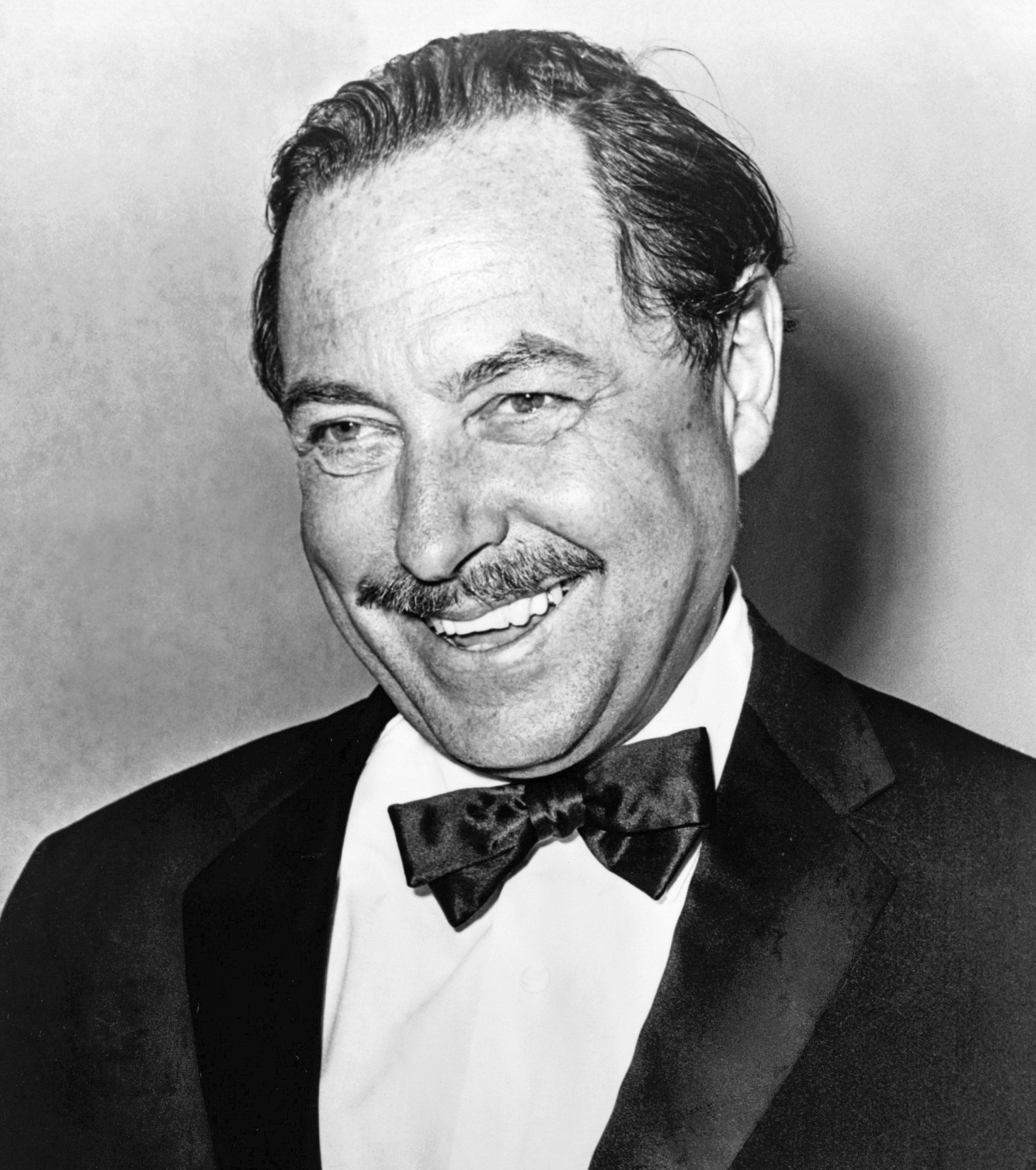
Maybe this is a slightly bizarre comparison, but as I finished reading the third paragraph of the chapter, where Mr. Edwards dies of asphyxiation by chicken bone, I couldn't help but think of Tennessee Williams, whom, as a writer at least, I respect hugely; as a person, well....  If you don't already know the connection I'm referring to, here is the applicable excerpt from Williams' entry at wikipedia:

File:Tennessee Williams NYWTS.jpg
Tennessee Williams
Williams died on February 25, 1983 at the age of 71.

Reports at the time indicated he choked on an eyedrop bottle cap in his room at the Hotel Elysee in New York. The reports said he would routinely place the cap in his mouth, lean back, and place his eyedrops in each eye.[6] The police report, however, suggested his use of drugs and alcohol contributed to his death. Prescription drugs, including barbiturates, were found in the room, and Williams' gag response may have been diminished by the effects of drugs and alcohol.

Williams' body was found by director John Uecker who was identified as his secretary and who travelled with Williams, and was staying in a separate room in Williams' suite.

(Back to the chapter)
  1. "This ending was no deterrent.  No one who is young is ever going to be old."
  2. Is there anything we can assume about Steinbeck's own morality--or self-perceived morality--from his use of the institution of the whorehouse and the description here at the beginning of chapter 9, as well as the fact that this, essentially, is where Cathy chooses to begin her climb to the top?
  3. Something about the idea of "interviewing" to fill positions at whorehouses seems very strange to me.
  4. Name change: Cathy Ames is now Catherine Amesbury.
  5. Why is prostitution (though she doesn't yet take it up) the perfect profession for Cathy?  Really, it fits her personality and her interests and abilities to a T.
  6. "[He] fell right into the oldest conviction in the world--that the girl you are in love with can't possibly be anything but true and honest."

Chapter 9.2

  1. "As a matter of business he had learned so much about women that he did not trust one for a second.  And since he deeply loved Catherine and love requires trust, he was torn to quivering fragments by his emotion."
  2. Predict: If we've established our Cains and our Abels (and there are yet more to come), what role, then, might Cathy fill, and what evidence supports your prediction?  (Consider her carefully calculated, unaffected use of Mr. Edwards.)
  3. A little past midway through 9.2, Steinbeck writes that Cathy is "afraid, living alone."  Did he, the mighty Steinbeck, mess up?  She doesn't seem--not immediately, anyway--as one who suffers from such a frivolous emotion as fear.  What reasons might she have to be afraid, and are these valid?  Also, considering that fear is an emotion--or sixth sense, if you want--specifically "designed" to keep us safe, why might Cathy actually be much more prone to fear than someone else?
  4. Does dunk work like this, or is Cathy superhuman?  (I'm no particular authority here; someone help us out.)
  5. What does the drunken violence reveal about Cathy's monstrosity?  Is she, and to what extent, in control?  Notice that she knows exactly what she wants and exactly how to get it.  She even knows how to repair damage done.  Via a discussion of her monstrosity, define her humanity--or her "human-ness."

Chapter 9.3

  1. "...in all his life he had never been in love with a woman."  When you think about it, Mr. Edwards and Cathy are quite similar.  How so and to what degree?
  2. "A man who can't learn from experience is a fool, he said."  This is speaking directly of Mr. Edwards, of course, but the same could easily be said of Cathy.  What does she learn--or inevitably will learn--from her experience with Mr. Edwards?
  3. Now at the end of chapter 9, do you feel sorry Cathy?

Tuesday, October 12, 2010

East of Eden X -- Nature versus Nurture

In comments to the Monster post, James brings up the issue, though not with these particular words, of nature versus nurture.  I guess I don't have my thumb adequately enough pressed upon the pulse of world discussion to know how hot-or-not this discussion is, but it crops up all the time in lit-talk.  Obviously, this applies directly to East of Eden, chapter 8 inasmuch as Cathy is a monster by nature.  Maybe that's another issue that needs to be addressed on the "Continuum of Monstrosity" -- a third dimension, or z-axis, showing whether the monster became so in its life and by influence of its surroundings or happens to be innately monstrous.

May I recommend a side project?  I think we should compile a manner of classification for monsters in literature and accurately project them on the continuum, including the third axis for nature/nurture.  I could probably draw it up by hand, but computer imaging would work better.  Stephen, are you reading this?  How hard would this be?  In the meantime, anyone reading this, we would need to compose questions and tiers delineating degrees of monstrosity in order to grid them on the image....  Thoughts?

So what do you think (back to nature/nurture and Cathy's monstrosity)?  Can you really be born monstrous, evil, terrible?  This is a big deal for many religions.  Are we born pure?  Are we born evil?  This is the dilemma--or perhaps point of contention--of, or between, many religions regarding baptism.  Where does the evil come from then, if not inborn?  Was Satan, Lucifer, the Son of the Morning, eternally evil, or did he become so?  I'm not trying to create a theological discussion or debate here.  When it comes down to it, in order to keep the discussion truly applicable to the source text, we need to tend within Steinbeck's own demonstrated belief system.  However, I don't think we need to limit ourselves!

So, chapter 8.

***

Reading Questions
Chapter 8.1, 8.2
  1. Simple and direct: if you want evidence that Steinbeck intends Cathy to be evil by nature, these two sections are loaded!  Consider how she, and entirely passive-aggressively, frames the two boys for sexual assault.  Sure, they're not innocent, but holy cow!  Can a person be that horrible and from that young?  Her father doesn't think so.  Does his passivity--or, at best, though still, I think, guilty by omission, silence--incriminate him?  Could he have NURTURED his daughter into something wholesome, or at least less evil?  Is a person born like Cathy capable of gaining some sort of purity?
Chapter 8.3
  1. I read this first paragraph and, forgive me, can't help but think of young Tom Riddle of Harry Potter fame requesting a teaching position from Dumbledore.  Why does she really want to be a teacher? (Do you suppose Rowling was in any way influenced by Steinbeck?)
  2. James Grew reminds me of Kurt Cobain. 
  3. Mr. Ames just ticks me off.  Maybe he reminds me of me.  Like him, I'm not confrontational.  Might it be also within me to ignore such impressions and cause, inadvertently and by laziness or cowardice, such destruction?  I hope not.  And is this not the great power of great literature, to reflect us upon ourselves?
  4. Steinbeck writes in the last paragraph of 8.3, "That was Cathy's method."  WHAT?  What is it that is Cathy's method?
Chapter 8.4

So I'm writing these questions and discussion points as I'm re-reading the book for the first time in three or four years (has it been that long?), and HOLY CRAP! I forgot about this brilliant exchange and cross-textual reference:
  • "What's that book you're hiding?" [her mother asks.]
  • "Here!  I'm not hiding it."
  • "Oh!  Alice in Wonderland.  You're too big for that."
  • Cathy said, "I can get to be so little you can't even seen me."
  • "What in the world are you talking about?"
  • "Nobody can find me."
  • Her mother said angrily, "Stop making jokes.  I don't know what you're thinking of.  What does Miss Fancy think she is going to do?"
  • "I don't know yet," said Cathy.  "I think I'll go away."
  • "Well, you just lie there, Miss Fancy, and when your father comes home he'll have a thing or two to say to you."  (Yeah, right!  That coward?)
  1. Keep this exchange in mind as you learn more and more about Cathy.  Is she really just a girl lost down the rabbit hole?
  2. Is Cathy without love or empathy?  Consider just the page or so since the Wonderland dialog.  Was it foresight that prevented evidence of childhood in her bedroom or careful erasure that left it empty after he departure?
  3. Interesting about Mr. Ames: the very thing that makes him a coward in confrontation is also--or is it? -- the very thing that makes him "a very good man in a crisis."
  4. The whipping scene makes me think--or, I guess, it's Cathy's reticence and utter control throughout the ordeal--of Denzel Washington's character in the movie Glory.  Thoughts?  Certainly, she's no martyr; there's no glory in her resistance, but still....


chapter 8.5
  1. "We've all of us got a little of the Old Nick in us," says Cathy's father.  Who is Old Nick?
chapter 8.6 
  • "Now look here, Mike," he said, "you shouldn't do a think like that.  If that poor fellow had been just a little smarter you might have got him hanged."
  • "He said he did it."  The constable's feelings were hurt because he was a conscientious man.
  • "He would have admitted to climbing the golden stairs and cutting St. Peter's throat with a bowling ball," the judge said.  "Be more careful, Mike.  The law was designed to save, not to destroy."

Monday, October 11, 2010

Podcast #1: MONSTERS (though not for their own sake)

So here it is: my very first podcast.  I'm sure it's clumsy.  I'm sure I'll get better with the next one.  And true to form, I'm probably way wordier than I need to be.  Pass on the feedback, the thoughts, the questions. 

Enjoy.

(Man, it's weird to watch yourself like this!)

part 1

***

part 2

The Continuum of Monstrosity,
original
(Did I always look bug-eyed while teaching, or is it just the camera angle?)

In case you can't read it on the video (and I don't know how you could):

Sunday, October 3, 2010

I NEED MONSTERS

In preparation for chapter 8 (East of Eden), an introductory "podcast" (yep, I'm going to do it!), the and discussion on the woman who began as Cathy Ames, I need your input on MONSTERS.

Classic monsters, but not by category--vampires, werewolves, zombies, Inferno, etcetera--I mean specific, individual monsters with names.  These can be from movies, they can be from books, they can be from comic books, songs, folk tales, family, whatever. 

some generic image of Grendel I found
There is one specific type of monster (though all monsters are needed!) I'm looking to focus on (the others I need for contrast's sake):

The TRICKSTER.  In Native American folklore, he's often called Coyote.  In European folklore and tales, he's often labeled Puck.  The problem I have with Puck--or pucks in general--is their general lack of deep malice.  The best example I can think of is Coyote himself, from Chabon's Summerland.  On the other end, there is Grendel, from Beowulf (from which a terribly awesome book, Grendel, was written by John Gardner).

The trickster is a liar.  A Father-of-all-Lies kind of character.  Who lies just to lie, or just to mess people up, or because it screws things up and that what he loves most.  Screwing things up. 

So, Folks, I need a LIST.  Monsters, people.  Movie fans, book fans, aficionados of horror:  Monsters.  Comment with the names of monsters.


And don't forget to sign up as follower and get your picture over there.  I'm doing a drawing soon.  That means free stuff, and as well all know:  FREE STUFF GOOD.
Related Posts Plugin for WordPress, Blogger...