* NOTICE: Mr. Center's Wall is on indefinite hiatus. Got something to say about it? Click HERE and type.
Showing posts with label fathers. Show all posts

Sunday, March 27, 2011

Sunday Poetry XXI -- One for My Daughter, One for Me

The quality of a poem is a very subjective thing.

Slumber Party
My party was the best one yet!
My friends came by and spent the night.
We had a crazy pillow fight.
We laughed until we cried.

My party was the best one yet!
We ate popcorn and watched TV.
We played dress-up and sang off-key.
We danced.  At least, we tried!

My party was the best one yet!
We whispered secrets all night through.
We listened to some records, too.
We played two games, or three.

My party was the best one yet!
And you know why it was such fun?
My friends!  Yes, each and every one
was there along with me.

—from Minnie and Me, My Favorite Book

***

I Tramp a Perpetual Journey
by Walt Whitman
I know I have the best of time and space, and was never measured and
    never will be measured.
I tramp a perpetual journey, (come listen all!)
My signs are a rain-proof coat, good shoes, and a staff cut from the woods,
No friend of mine takes his ease in my chair,
I have no chair, no church, no philosophy,
I lead no man to a dinner-table, library, exchange,
But each man and each woman of you I lead upon a knoll,
My left hand hooking you round the waist,
My right hand pointing to landscapes of continents and the public road.

Not I, not any one else can travel that road for you,
You must travel it for yourself.

It is not far, it is within reach,
Perhaps you have been on it since you were born and did not know,
Perhaps it is everywhere on water and on land.

Shoulder your duds dear son, and I will mine, and let us hasten forth,
Wonderful cities and free nations we shall fetch as we go.

If you tire, give me both burdens, and rest the chuff of your hand
    on my hip,
And in due time you shall repay the same service to me,
For after we start we never lie by again.

This day before dawn I ascended a hill and look'd at the crowded heaven,
And I said to my spirit When we become the enfolders of those orbs,
    and the pleasure and knowledge of every thing in them, shall we
    be fill'd and satisfied then?
And my spirit said No, we but level that lift to pass and continue beyond.

You are also asking me questions and I hear you,
I answer that I cannot answer, you must find out for yourself.

Sit a while dear son,
Here are biscuits to eat and here is milk to drink,
But as soon as you sleep and renew yourself in sweet clothes, I kiss you
    with a good-by kiss and open the gate for your egress hence.

Long enough have you dream'd contemptible dreams,
Now I wash the gum from your eyes,
You must habit yourself to the dazzle of the light and of every
    moment of your life.

Long have you timidly waded holding a plank by the shore,
Now I will you to be a bold swimmer,
To jump off in the midst of the sea, rise again, nod to me, shout,
    and laughingly dash with your hair.

Wednesday, February 16, 2011

Wednesday's for Kids XIII -- FORGOTTEN SEUSS

I think it may actually be impossible to claim yourself a book-lover and yet not like, or at least appreciate (that ever snobby word for those stuffy and shallow enough to attempt to save face amidst the true bibliophiles) Dr. Seuss (his books, I mean; I don't know much about the actual man behind them).  In fact, I would be interested to know if you or someone you know may be one who actually does dislike him--err, his books, I mean (and "dislike" being the mildest, though I'm sure there's someone out there--likely a non-book lover, but perhaps not--who just flat out despises him).  But I have a problem.  My problem is indeed with his books and is two-fold: 1, there are so many of them (which, of course, is also a strength, but without which this next wouldn't happen); and 2, so many of the very best are forgotten because of what pop-culture and bookstores (the latter parcel to the first, of course) does to only a handful.

I have three favorite titles by Seuss.  None of them have I ever seen at a Barnes and Noble.  None have been made into a movie--or at least some massive wide-release travesty (thank Heaven! (though, done right, maybe they wouldn't be so bad)).  Nowhere have I found a student even who's ever heard of more than one.

I am not going to dwell on the stories, metaphors, and characters of each, but simply show their covers, list their titles, and little else.

What do I recommend?  Get the books.  Buy them.  Put them on your shelves, but not in the children's section, but right between, say, Salinger and Tennyson, where they belong.

NUMBER 1: Horton Hatches the Egg, surely forgotten in large part because of the book's big, though nonetheless great (just hackneyed by the evil Pop!), brother, Horton Hears a Who.


NUMBER 2: Scrambled Eggs Super, a long-time favorite of mine, and even before my Dad's renown for his ability to recite the entire thing word-for-word, as well as a now-favorite of my kids.


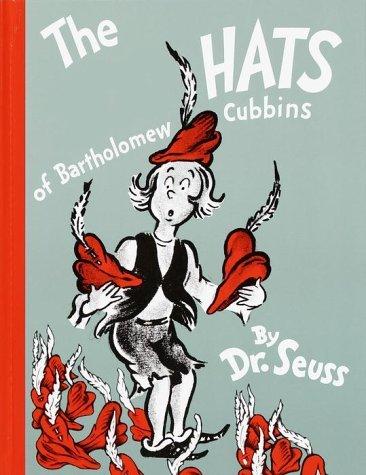
NUMBER 3: The 500 Hats of Bartholomew Cubbins, which is a rare example of a story without rhyme, as well as one of, if not, the longest stories Seuss wrote.

(I don't know what happened to the "500"...)
Each of these books is as rife with character, fun, and real-world application as any of his classics with more mega-media face-time; I argue, however, that these are, perhaps, lucky to be at least partially forgotten, as certainly characters like Horton and the Cat in the Hat have only suffered at the attention of Hollywood's heavy, oh-so-un-holy hand.

Gee Whiz: In searching pictures of the books, I stumbled upon this of the Hebrew translation for Scrambled Eggs Super; how spectacular that they thought to reverse the cover art!

Monday, November 29, 2010

East of Eden XLVII -- chpt47: WHO IS TO BLAME?

Reading Questions
Chapter 47.1

  1. I've noticed a version of Adam's sternness for "excuse and borderline disability" in myself and my teaching.  Though he is weak, though he hates the war and feels he's condemning the boys he sends off, why won't he accept the excuse (which is the same reason he wouldn't be able to hold back his boys)?


Chapter 47.2

  1. There's an interesting question here, which could be answered pertly, tritely, but whose answer could be much more revelatory: If God puts together two boys in a family--Cain and Abel, Charles and Adam, Cal and Aron--and one of them kills the other, even if perhaps there was reasonable doubt that they'd live well together and build each other up, is God responsible?
  2. "All great and precious things are lonely."  (I don't think I agree--or I do agree, but with exceptions.)


Chapter 47.3

  1. Twice now, unless I'm missing one, Cain has remained in "Eden" and Abel has left the garden for the weedy world beyond--war and college.  What is Steinbeck saying by this, as it is not the only reversal from the Bible story?
  2. Could Aron live on and work the farm?  It isn't a question regarding Cal.  Yes, he could.  But here we see the greatest similarity between Aron and Adam.  What is it?  (And if Aron has such distinct similarities to both his parents, what is there about Cal that is at similar to his father, if it is Adam at all, as we see clearly what his similarities are to Cathy?)

Thursday, November 18, 2010

East of Eden XXXVII -- chpt37: LETTUCE-HEAD

Reading Questions
Chapter 37.1
  1. Why did Lee never fully unpack before now?
  2. Notice, via Adam's obsession with ice, that Sam Hamilton yet lives, and will likely live eternally.
  3. There is great potential irony in a business plan regarding refrigeration, especially in the context of a book that has one family of immortals and another family recently resurrected.
  4. It comes out: how does Will really feel about his father?  Also, it is very easy and natural for a reader to highly idealize both Sam and Tom; look at it from the other side, and instead of villainizing Will, defend him.
  5. Is Will right?  When people ask advice, do the really only want the advisor to agree with them?
Chapter 37.2
  1. Adam's smile here after the news of the lettuce reminds me an awful lot of the smile he wore after gaining freedom from his wife.
  2. The whole episode of the lettuce makes me uncomfortable the way a situational comedy makes me uncomfortable.  In such a comedy, I know what's going to happen, and there's nothing I can do about it, and if the victim only followed sound advice to begin with, wasn't quite so stubborn, and possessed an only slightly greater portion of intelligence--which intelligence every reader of this book believes he/she possesses--it wouldn't happen!  But there's an issue of fate going on here.  Was Adam fated to lose this investment?  Whether yes or no, how does this play with the themes of the book, especially that of Timshel?
  3. As Adam is deemed a fool, how might he feel about being a "fool like Sam Hamilton?"
Chapter 37.3
  1. Dad fails and Aron moans and groans, and the trouble leads him to second guess everything about his father, including his love.  Dad fails, and what will Cal do, if his personality indeed dictates his actions?

Tuesday, November 9, 2010

East of Eden XXIX -- chpt28: LOVE. PERIOD. (not that kind of love)

I am always deconstructing authors' goals and intentions as I read.  What makes them tick, and how are they trying to accomplish exactly what they're trying to accomplish, and why did they do this that way or this way or how, and--in the case of Steinbeck and others whose work I'm always burrowing through and panning--why is it assembled as it is?  I mentioned quite some time ago the impression I get that this book was not planned out beyond a potential list of characters, general plot motivation, and a setting.  One of the reasons I feel this way is my inability (nearly always absent from a reading) of why a chapter was put together in such-and-such a way.  So many of these chapters with their mini-chapters stump me.  And perhaps this is one of the reasons Grapes of Wrath won all the awards and this is merely everyone else's favorite.  Yes, it is less polished, but I don't think it suffers from the lack of sheen; rather, I think its rustic quality enhances it.  But I look at chapter 28 specifically, and I can't figure out the assembly of these three parts--the thematic line drawn through them.  Shouldn't there be?  Such thematic drawstrings bind up all his paragraphs, bind up his sub-chapters, bind up the book as a whole.  Why not his chapters?  Or am I missing something--looking tooo hard?  I hate to say it, because it just seems to darn easy, but could it really be something as simple as time?  I don't want it to be; I want there to be more.  Why isn't it enough?

And yet, reading it again for the sake of writing these questions--and as I come up with a title for this entry--what about love?  Do we not see three distinct, and perhaps more fully demonstrated than the typical examinations, forms or manifestations of love?  Fatherly, communal, fraternal?  Perhaps this is the most Christian of chapters in the book, which book is profoundly Christian.  (And I hope I'm not overstepping myself by saying it.  Maybe "Christian" is a pigeonhole of the broader topic--just what I'm titling this entry....)

Reading Questions
Chapter 28.1

  1. Hail the valient and hopelessly flawed father!  Every father is, and especially those who won't admit it or are totally oblivious to their ineptitude.
  2. What about Cal's search for anthills?  I picture myself driving home in the fall back in my high school days and seeing mountains of leaves piled up along the side of the street.  Impulsively I swerve the car and splash up a great rooster tail and make it home a little more invigorated than I would have had I been just that much more conservative.  Then I hear on the news (later that very season in fact) about homeowners planting bricks, rocks, or cinder blocks under their leaves to get even with the careless drivers wrecking the fruits of their labors.  Needless to say, I don't go barelling through piles of leaves anymore.  But does Cal think ahead at all, and mean further than, "Hey, let's wreck something and if I kick it this way I know I'll really wreck it," or is his wrecking of anthills heedless and impulsive?

Chapter 28.2

  1. Lee's story.  Who needs the telling of it more, Lee or Adam?  (Trick question.  The answer is neither.  Read my mind!  What am I talking about?) 
  2. I will say no more; this story--and maybe I am satisfactorily like Samuel in this regard--is sacred and doesn't need my defense or pathetic disections, so I will leave it to you.  Regarding Samuel, consider Lee's words after Adam asks if he ever told the great man: "No.  I didn't.  I wish I had.  He loved a celebration of the human soul.  Such things were like a personal triumph to him."  What triumph's of the human soul have you recently witnessed and/or celebrated?

Chapter 28.3

  1. Why is the re-newed impulse to write Charles suddenly strong enough--or Adam finally subjectible enough--to actually bring about a letter?  (And I love how obviously self-conscious the writing is, which writing doesn't even feel forced by Steinbeck.  That's talent, my friends.  Talent!  (Don't believe me?  Try it!))
  2. Adam's PS is apropos.  Up to that point in the letter, ask yourself, why does Adam so love Charles?  A love that is clear--now, if it wasn't over the past ten years.  The answer is simple: "...because you were my brother." 

Thursday, October 28, 2010

East of Eden XXIII -- chpt22: BAPTISM, minus the water

Reading Questions
Chapter 22.1

  1. I can't help but think of couples who lose a child, which loss destroys their relationship, overcoming the love they have for each other, such that they can't find it--if it even continues to exist (is such a thing terminable? I think so).  Is Adam experiencing something like this or, as its his spouse and his children remain, is it entirely different?
  2. What does it mean that "Adam might be pleasuring himself with sadness"?
  3. It is interesting, the magic Samuel works on those around him: Lee is the prime example.  Notice how Lee's walls and masks simply slack from him when no one else is around.  It is the same, to a degree, with his children.  People are more themselves around Samuel (of course, this seems only to be the case for those who have something to hide behind: Liza is entirely bald and naked with or without him).  Does this eventually--as it hasn't until this point--work on Adam?  Is the "shocking" he's setting out to perform a bit of his wife creeping into his person?

Chapter 22.2

  1. Does Liza think it's important that the boys have names at this point?  It would seem to me that perhaps she doesn't, at least inasmuch as it isn't her or anybody else's business.  If this is the case however, why does she say, quite clearly, "If you do not get those boys names, there'll be no warm place in this house for you.  Don't you dare come whining back, saying he wouldn't do it or he wouldn't listen.  If you do I'll have to go myself"?  (And she smiles when she aggravates him to shouting!  WHY!?)
  2. What a beautifully self-contradictory woman!  Does she bring out--or provoke--the best in Samuel as a spouse should?

Chapter 22.3

  1. Ah!  The words of a hero (I think I will have this written on my grave): "A man, his whole life, matches himself against pay.  And how, if it's my whole life's work to find my worth, can you, sad man, write me down instant in a ledger?"  (Oh, it makes my heart sing!)
  2. Liza says it herself, that her husband's words are honey--poetry, true--Steinbeck's own, like some of the richest descriptive passages from Tortilla Flat (my pet favorite of the man's): "In a bitter night, a mustard night that was last night, a good thought came and the dark was sweetened when the day sat down.  And this thought went from evening star to the late dipper on the edge of the first light--that our betters spoke of.  So I invite myself."
  3. And Samuel's righteous indignation like the mighty wrath of a prophet for his God!  "Tear away with your jelly fingers.  You have not bought these boys, nor stolen them, nor passed any bit for them.  You have them by some strange and lovely dispensation....  The stone orchard celebrates too little, not too much."
  4. And Adam's defense (is it valid--really, is it!?): "What I do [or don't do] is my own business" speaking of his not having "laid a number" to his sons.
  5. And imagine the force of the stubborn old farmer's fist on the heathen's jaw!  I met a farmer in Italy once.  I've always thought of this particular gentle giant when I've read this passage from the book.  The man towered over me, pushing seven feet, with bones too big for his skin.  I don't have small hands, but when he took mine in his for a handshake, my little paw DISAPPEARED TO ABOVE MY WRIST.  I picture a fist like this--literal or figurative with its godly power--crashing into Adam's listless face.
  6. How are the boys naked without names?  They're still only babies.  With what exactly--more than one thing--will they be clothed once the names, with Adam's help and approval, are chosen and assigned?
  7. Proof of Samuel's success?  "It's hard to imagine I'd thank a man for insults and for me out like a rug.  But I'm grateful.  It's a hurty thanks, but it's thanks."
  8. Why do we need to sort out emotion--to label them as loss or hate or loneliness or whatever?  How will alleviating this confusion of labels help Adam ascend from his dearth?
  9. A point regarding NATURE vs NURTURE: "And I will warn you now that not their blood but your suspicion might build evil in them.  They will be what you expect them to be.  ...  I don't very much believe in blood.  I think when a man finds good or bad in his children he is seeing only what he planted in them after they cleared the womb." //  From Adam: "You can't make a race horse of a pig." //  From Samuel: "No, but you can make a very fast pig."  Interesting, as this makes sense coming from Samuel, who's raised to adulthood a huge family, but not so much coming from Steinbeck, who, at the time, has only two young boys, and he's not even the one really raising them!  What do you think?  (Ad astra per alia porci.)
  10. I repeat a question from before: Whose children are these boys?
  11. "I'd think there are degree of greatness," Adam said.  //  "I don't think so," said Samuel.  "That would be like saying there is a little bigness."
  12. Twice in this section, Samuel refers indirectly to Jesus Christ.  Once, regarding himself to be inherently too mediocre and cowardly to face crucifixion, and second, in Lee's position as a servant and a likely greater man than he or Adam will ever be.

Chapter 22.4

  1. Wise Lee, regarding the negative connotation of the name, Cain, and that it's perhaps never been borne since: "Maybe that's why the name has never changed its emphasis."
  2. How patient Steinbeck is as an author.  There's no rushing into the naming.  He's got something important in common with his Cathy Ames.  The moment comes as and when it will, and in the meantime he waits and takes advantage of the available moments for his further advantage.
  3. "No story has power, nor will it last, unless we feel in ourselves that it is true and true of us."  What stories do you know and/or have read that, by this standard, are true?
  4. Adam displays a personal moment of hope--of self-hope: "Well, every little boy thinks he invented sin.  Virtue we think we learn, because we are told about it.  But sin is our own designing."  Yet is is also tinged with hopelessness, and with it, MASSIVE foreshadowing for both event and theme: "Because we are descended from this.  This is our father.  Some of our guilt is absorbed in our ancestry.  What chance did we have?  We are the children of our father.  It means we aren't the first.  It's an excuse, and there aren't enough excused in the world."
  5. Does Adam have any inclination--even akin to deja vous--that as he defends Cain he defends his brother?
  6. Samuel: "I think this is the best-known story in the world because it is everybody' story."  (This, by the way, is the essence of the definition of Myth--not myth=fiction, but myth=foundational literature and history, true or not.)
  7. "But [Aaron] didn't make it to the Promised Land."
  8. Why does Samuel tear up in the final paragraph?

Thursday, September 30, 2010

East of Eden V (the Rest of Chapter 3): The Fall of Gods

"When a child first catches adults out--when it first walks into his grave little head that adults do not have divine intelligence, that their judgments are not always wise, their thinking true, their sentences just--his world falls into panic desolation.  The gods are fallen and all safety gone.  And there is one sure thing about the fall of gods: they do not fall a little; they crash and shatter and sink deeply into the green muck.  It is a tedious job to build them up again;  they never quite shine.  And the child's world is never quite whole again.  It is an aching kind of growing" (East of Eden, chapter 3.2, 1, emphasis added).

I remember when my dad fell from grace.  It wasn't a far fall, thankfully; I think anything drastic might have destroyed me.  I worshiped my dad.  Now, though he's certainly still one of my heroes (and hanging out around the top of the list), I have the benefit of disillusionment, which, wonderfully, makes it possible for him to be my friend.  The moment my dad fell--well, no, stepped--from his pedestal was during a drive out into the Ohio countryside to visit some people from church.  I'd just returned home for a break from college, and we were talking about work.  I complained about the annoyances of dealing with people--customers--and he said, likewise, that that was the hardest part of being a veterinarian.  More than that, I asked directly, "Dad, do you even like being a vet?"  He hesitated a moment, took a deep preparatory breath--sort of one of those, ah, what the heck kind of breaths--and said--  and I'm going to interrupt just a moment to say that my father's use of vulgarity of any sort, or words spoken in even the greatest anger, extends merely to the words bananas and nuts.  That's it.  He doesn't yell.  He doesn't swear.  He is mild.  (back to the story now.)  He looked at me and said, "You know, Joe, I'm just really tired of cutting the balls off dogs."

Secondly, and I think this is actually pertinent at an interpretive level, I can't help but remember the moment in the last Harry Potter book, The Deathly Hallows, when Hagrid and Harry crash the motorcycle after their little tussle with the Death Eaters.  There's Hagrid, a mighty giant, spread-eagle and face-down in a grimy green pond.

Yesterday, I challenged readers to describe Cyrus in a sentence.  Steinbeck has done it for us, via the boy, Adam:

"...[he] was not a great man, ...he was, indeed, a very strong-willed and concentrated little man wearing a huge busby."

However, this portion of the chapter makes it possible for us to actually look at the mand with a modicum of respect.  Is he really so bad?  After all, he loves Adam better?

There aren't going to be tons of questions here, though I could certainly ask them all that come to me as I read, but there's really no point.  The deep issues here--the relationships between brothers and sons/fathers--repeat and repeat.  Rather than disecting, perhaps we can connect.  What in your lives has been like whatever aspect(s) of Adam's--or anyone else's--experience?  The majority of the stuff here is going to be quotations.  Relate to them.  Connect them to yourself, other literature, other people.
***

Reading Questions 4
Chapter 3.2

  1. Is it true that there is some violence in everyone?
  2. In childhood, how well did Charles know his older brother?  Was he aware of the "rich full life that went on" behind Adam's "quiet eyes?"  Was Adam indeed a helpless thing, like "a puppy or a new baby?"
  3. "Adam was glad of Charles the way a woman is glad of a fat diamond."  How does this (together with what Steinbeck actually writes of it) speak of the emotions between the boys--"love, affection, empathy...."
  4. "For Alice had been naked--she had been smiling."
  5. Review and explain: What are Adam's tunnels?

Chapter 3.3

  1. The beating of Adam by Charles, and Charles's utter lack of remorse or, much less, apology, which, according to Adam (or narrator?), was Charles's "one great quality," and the contrast of all this against Alice's seeming tenderness, which was somehow echoed by a softening also of old Cyrus.
  2. How does Charles feel about the exclusion from certain conversations between Adam and Cyrus?  Use this as an explanation of some sort--rationalization--for the beating.  What danger does Adam pose to Charles by beating him at his own game?  Or is it something totally simple like the childish need for everything to stay the same, the violation of which easily insights insecurity and violence?
  3. "You can drive a human too far.  ...  Always you must leave a man one escape before death."
  4. Justify the benefits of permitting yourself to hit bottom, which, according to Cyrus, seems to be the soul's panacea!
  5. The requirement for Adam's enlistment is as dire as that of keeping Charles home.  Will this bring them closer together, narrowing the gap of their differences?
  6. "I love you better.  Else why would I have given myself the trouble of hurting you?"

Chapter 3.4

  1. We see the obviousness of Cain and Abel.  Anticipate the murder, but don't expect it to be literal.  If it was literal, after all, the malice, jealousy, and love (all simultaneously present) culminating in some sort of violence couldn't perpetuate itself, thereby robbing us of, 1, the rest of the novel, and 2, one of the great themes of the book, to be seen later.
  2. Did God love Abel better?
  3. What is it like to go blind--literally, morally, whatever-ly--with rage?  Is this what Charles experiences when violence surfaces?
  4. Is Charles evil?
  5. "Doppelganger" is often slightly misinterpreted.  How does it apply here?
  6. Cyrus tells Adam, "...you're always protecting him!  Don't you think I know that?"  Discuss the irony.
  7. Does anyone KNOW Charles?
Related Posts Plugin for WordPress, Blogger...